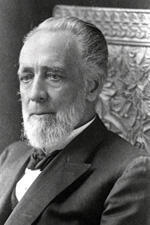
Henry Moore Teller (May 23, 1830 – February 23, 1914) was an American politician from Colorado who served as a United States senator between 1876 and 1882 and again from 1885 to 1909, and as Secretary of the Interior from 1882 to 1885. Over the course of six terms in the Senate, he represented Colorado during a significant period in American history, contributing to the legislative process on issues ranging from monetary policy to Native American affairs and U.S. expansion overseas. A member of the Republican Party for much of his early career, he later became a leader of the Silver Republican Party and ultimately served as a Democratic senator from Colorado. Among his most prominent achievements was authoring the Teller Amendment, which definitively stated that, following the Spanish–American War, the United States would not annex Cuba but would intervene to help it gain independence from Spain.
Teller was born into a large Methodist family on a farm in Granger, Allegany County, New York, on May 23, 1830. He was educated at local academies in western New York and, like many young men of modest means in the mid-nineteenth century, turned to teaching to finance his professional training. While teaching, he read law in the office of Judge Martin Grover in Angelica, New York, and was admitted to the New York bar in 1858. Seeking broader opportunities in the rapidly developing Midwest, he moved that same year to Morrison, Illinois, where he practiced law for about three years and took part in organizing the emerging Republican Party in Illinois.
In 1861, as the nation moved into civil war and the Rocky Mountain mining regions were opening to settlement, Teller relocated to Central City in what was then Colorado Territory, where he established a law practice. He married Harriet M. Bruce, and the couple had two sons and a daughter. Teller quickly became prominent in territorial affairs. During the “Indian troubles” of the early 1860s, when the Arapaho and Cheyenne peoples were being forced from the eastern plains of Colorado, he was appointed major general of Colorado’s territorial militia in 1863, a position he held until 1865; he later served as major general of the Colorado militia from 1864 to 1867. In 1865 he was one of the chief organizers of the Colorado Central Railroad, drafting its original charter and serving as its president for five years. Until Colorado achieved statehood, he built a successful career as a corporate attorney, gaining the prominence that would lead to his selection for the United States Senate once the territory entered the Union.
Following Colorado’s admission to the Union in 1876, Teller was elected by the state legislature as one of the new state’s first U.S. senators. He initially served a brief three‑month term to fill the remainder of an unexpired term and was then elected to his first full six‑year term. He was reelected repeatedly, ultimately representing Colorado in the Senate for more than a quarter century. His service in Congress occurred during a transformative era marked by Reconstruction’s aftermath, rapid industrialization, western expansion, and contentious debates over monetary policy and federal Indian policy. Beginning around 1880, Teller became ardently identified with the Free Silver cause, advocating bimetallism as a means of expanding the money supply to aid farmers, miners, and debtors in the West. He worked vigorously, in and out of Congress, to secure declarations in favor of bimetallism and became a conspicuous actor in the prolonged Senate struggle against the unconditional repeal of silver‑supporting legislation following the 1892 Republican National Convention.
On April 17, 1882, after Secretary of the Interior Samuel J. Kirkwood resigned, President Chester A. Arthur appointed Teller to head the Department of the Interior. Teller resigned his Senate seat and served as Secretary of the Interior from 1882 to 1885. In that role he oversaw the Bureau of Indian Affairs and became one of the most outspoken opponents of the allotment of Native American lands. He strongly opposed what became the Dawes Act, intended to break up communal Native American lands and force assimilation, accurately stating that it was directed at forcing Native peoples to give up their land so that it could be sold to white settlers. In 1881 he warned that allotment was a policy “to despoil the Indians of their lands and to make them vagabonds on the face of the earth,” arguing that provisions ostensibly for the benefit of Native Americans were merely a pretext to open their lands to non‑Indian settlement. Subsequent history bore out his prediction, as Native landholdings declined from about 138 million acres in 1887 to roughly 48 million acres by 1934. At the same time, Teller’s record on Native affairs was complex and often contradictory. As Secretary, he supported reforms in Native American schooling but also approved the 1883 Indian Religious Crimes Code, drafted by Commissioner of Indian Affairs Hiram Price, which sought to suppress traditional ceremonial practices, dances, plural marriage, and other customs through “Courts of Indian Offenses” empowered to impose imprisonment and withhold rations. He installed Indigenous judges to enforce these measures, which were aimed at eradicating traditional cultures on reservations; these policies remained in force until they were reversed under Commissioner John Collier in 1934.
Teller returned to the Senate in 1885 and resumed his leadership on monetary and western issues. As the national Republican Party moved decisively toward the gold standard, Teller and other westerners resisted. At the 1896 Republican National Convention, when the party adopted a platform committing it to the gold standard, Teller and twenty‑four other delegates dramatically walked out in protest. He then joined and became the leading figure in the Silver Republican Party, a short‑lived organization that sought to maintain traditional Republican positions on many issues while breaking with the party on silver and monetary policy. As bimetallism receded from national politics and the Silver Republican Party lost influence, many of its adherents returned to the Republican fold. Teller, however, refused to rejoin the Republicans and instead aligned himself with the Democrats. With the decline of the Silver Republican organization, he served as Colorado’s Democratic senator for the remainder of his tenure until 1909 and played a significant role in helping the Democratic Party gain strength in a state that had previously been dominated by Republicans.
During the Spanish–American War in 1898, Teller gained national prominence for his role in shaping U.S. policy toward Cuba. He authored and influenced the adoption of the Teller Amendment, an amendment to the joint resolution authorizing war with Spain, passed by Congress on April 19, 1898. The amendment declared that the United States would not annex Cuba and that the purpose of American intervention was to assist the Cuban people in securing their independence from Spain. Teller believed that the United States should support the Cuban War of Independence for an autonomous Cuban nation and articulated a broader principle that peoples should live under flags of their own choosing. He later stated that while the American flag was “the best flag in the world for Americans,” it was not the best flag for those who did not desire it, asserting that liberty‑loving peoples would never truly love a flag they had not themselves created and defended. Although the Teller Amendment initially shaped a diplomatic posture favoring Cuban independence, its effect was later limited by the Platt Amendment, which imposed conditions on Cuban sovereignty until its abrogation in 1934. Teller also took strong positions on immigration, notably supporting the Scott Act of 1888, which reinforced and extended the Chinese Exclusion Act of 1882. He declared in debate that he would “welcome any legislation that shall deport every single one” of the roughly 100,000 Chinese laborers then in the United States and “send them back to China, where they belong,” reflecting the exclusionary and racially discriminatory attitudes of the era.
After approximately thirty‑three years of service in the Senate, Teller retired from Congress in 1909. He returned to Colorado and resumed the practice of law, remaining a respected elder statesman in Denver and in state political circles. He continued to be associated with the issues that had defined his career, including western development, monetary policy, and federal Indian policy, although he no longer held public office. Henry Moore Teller died in Denver on February 23, 1914, and was buried in Fairmount Cemetery. His long career, spanning territorial Colorado through the Progressive Era, left a complex legacy marked by vigorous advocacy for western and silver interests, a prominent role in shaping U.S. policy toward Cuba, and a contradictory record on Native American rights and cultural suppression.
Congressional Record