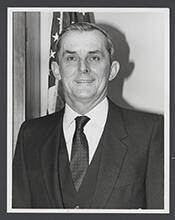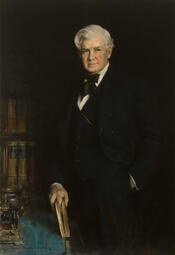
Henry Thomas Rainey (August 20, 1860 – August 19, 1934) was an American politician and a long-serving Democratic Representative from Illinois who rose to become Speaker of the United States House of Representatives during President Franklin D. Roosevelt’s “Hundred Days” in 1933. Over the course of 15 terms in Congress, he represented his Illinois constituents through a period that spanned the Progressive Era, World War I, the 1920s, and the early New Deal, contributing to the legislative process during a transformative era in American history.
Rainey was born on August 20, 1860, and attended public schools in Illinois before pursuing further studies at Knox Academy and Knox College in Galesburg, Illinois. Seeking a broader academic experience, he transferred to Amherst College in Massachusetts, from which he graduated in 1883. He then returned to the Midwest to study law at Northwestern University School of Law in Chicago, completing his legal education there in 1885. That same year he was admitted to the bar and commenced the practice of law in Carrollton, Illinois, establishing himself as a young attorney in Greene County.
Early in his career, Rainey combined legal practice with public service. He was appointed master in chancery for Greene County, Illinois, in 1887, a judicial-administrative position in which he handled equity matters for the local courts. He held this post until 1895, when he resigned and returned full time to private legal practice in Carrollton. Outside his professional duties, Rainey was active in civic and fraternal organizations. The 1903 Congressional Directory recorded that he belonged to the Knights of Pythias, the Independent Order of Odd Fellows, the Modern Woodmen, the Mutual Protective League, and the Elks, reflecting his engagement in the social and associational life of his community.
Rainey entered national politics at the turn of the twentieth century. Running as a Democrat, he was elected to the United States House of Representatives from Illinois in 1902 and took his seat in the Fifty-eighth Congress on March 4, 1903. He served continuously from 1903 to 1921, winning reelection for nine consecutive terms and participating in the legislative debates of the Progressive Era and World War I. In the 1920 election, amid a strong national tide favoring Republicans, he was defeated for reelection by Guy L. Shaw and temporarily left Congress at the close of his term in 1921.
Two years later, Rainey successfully returned to electoral politics. He regained his House seat in the 1922 election and reentered Congress in 1923, beginning a second long stretch of service that continued without interruption until his death in 1934. Over these years he became a senior figure in the Democratic caucus, representing Illinois in the House during the turbulent early years of the Great Depression. His combined service from 1903 to 1921 and from 1923 to 1934 totaled 15 terms in office, during which he consistently participated in the democratic process and represented the interests of his constituents in Illinois.
The economic and political upheavals of the Great Depression reshaped Rainey’s role in Congress. In the 1932 elections, the Republican Party lost its majority in a landslide, and the Democrats gained control of the House. With John Nance Garner elevated to the Speakership in the Seventy-second Congress, Rainey sought a leadership position within the new majority. He ran for and defeated John McDuffie for the post of House Majority Leader, while McDuffie remained as party Whip. This promotion placed Rainey at the center of legislative strategy as the nation prepared for the incoming Roosevelt administration.
Rainey’s influence reached its peak in 1933. When Franklin D. Roosevelt assumed the presidency on March 4, 1933, John Nance Garner left the Speakership to become Vice President. As Majority Leader and next in line in the House hierarchy, Rainey was elected Speaker of the House when Roosevelt called a special session of Congress two days later, inaugurating the famous “Hundred Days.” As Speaker, Rainey gave the Roosevelt administration what contemporaries described as virtually carte blanche to advance its program, facilitating the rapid passage of much of the early New Deal legislation with little or no change. Under his leadership, Congress enacted sweeping banking, agricultural, and relief measures during the special session and continued to pass additional reforms during the regular session that began in December 1933.
Henry Thomas Rainey remained Speaker and a central legislative ally of the Roosevelt administration until his death. He died of a heart attack on August 19, 1934, the day before his seventy-fourth birthday, before the newly elected Congress could convene. His death in office placed him among the members of the United States Congress who died while serving between 1900 and 1949. Rainey’s long tenure, culminating in his stewardship of the House during the critical opening phase of the New Deal, left a distinct mark on the legislative history of Illinois and the nation.
Congressional Record