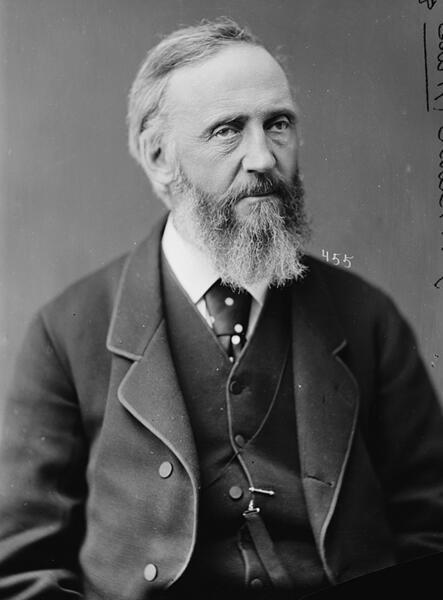
Henry Lillie Pierce (August 23, 1825 – December 17, 1896) was a United States Representative from Massachusetts, an industrialist who built the Walter Baker & Company chocolate enterprise into a nationally known brand, and a two-time mayor of Boston. A member of the Republican Party, he served in the Forty-third and Forty-fourth Congresses from 1873 to 1877, representing Massachusetts during a significant period of Reconstruction-era politics.
Pierce was born in Stoughton, Massachusetts, on August 23, 1825, the son of Colonel Jesse Pierce (1788–1856) and Elizabeth Vose Lillie Pierce (1786–1871). Stoughton at that time included what later became Dorchester’s Lower Mills district, where his family would eventually settle. His father, a staunch Methodist, had been an educator at Milton Academy and later served in the Massachusetts House of Representatives, while also maintaining a large gentleman’s farm in Stoughton. Henry grew up in this environment of education, public service, and agriculture, alongside his brother Edward Lillie Pierce, who would later attend Brown University. In 1849 the family moved from the Stoughton farm to Washington Street in the Lower Mills of Dorchester, reflecting their increasing ties to the commercial and industrial life of the Boston area.
Pierce received his early education at Milton Academy and then attended the State normal school at Bridgewater (now Bridgewater State University), where he pursued classical studies and teacher training. Although he did not ultimately follow his father into education, this formal schooling prepared him for both business and public life. After leaving Bridgewater, he turned to manufacturing and commerce, entering what would become a lifelong association with the chocolate industry.
In 1849, Pierce was hired by Walter Baker, owner of the Baker Chocolate Company and half-brother of Pierce’s mother, to work as a clerk at the firm for three dollars a week. Their relationship was strained by sharp political disagreements—Pierce was an outspoken Free-Soiler—and after about a year he left the company and went west to engage in newspaper work in the Midwest. At the request of Sydney Williams, Baker’s brother-in-law and managing director of the chocolate mill, Pierce returned to Boston after a year and was appointed manager of the Walter Baker counting house at 32 South Market Street in Boston, in what is now the Quincy Market area. Following the deaths of Walter Baker in 1852 and Sydney Williams in 1854, the trustees of the Baker estate, aware that Pierce had been with the company only a short time, leased the chocolate business to him on a two-year probationary basis, subject to a life interest payable annually to Mrs. Baker until her death in 1891. He began manufacturing under the name and style of Walter Baker & Company and, as his management proved successful, the trustees extended the lease in 1856 for eight additional years and then continued it in successive ten-year terms until 1884, when all provisions of the Baker will had been satisfied and the entire property was conveyed to Pierce.
Over the next four decades, Pierce transformed Walter Baker & Company into a major industrial concern and created what amounted to an urban mill village along the Neponset River in Dorchester Lower Mills. In 1860 he purchased the Preston Chocolate Mill, and in 1881 he acquired the chocolate mill of Josiah Webb, thereby consolidating competing operations in the district. The trustees renewed his lease in 1864 for a second decade, a period during which Pierce aggressively entered his chocolate and cocoa in competitive exhibitions at home and abroad. Baker’s products won an award at the Paris Exposition of 1867, the highest awards at the Vienna Exposition of 1873, and again at the Philadelphia Centennial Exposition of 1876. With the assistance of mill managers and employees, he expanded production and built new mills, equipping them in 1894 with modern chocolate-making machinery, much of it imported from Germany, that reduced power consumption and simplified operation. Under his ownership, Walter Baker Chocolate was notable for its lack of labor unrest, and Pierce was widely regarded as a kind and well-paying employer. In 1883 the company formally adopted La Belle Chocolatière, copied from Jean-Étienne Liotard’s 18th-century painting The Chocolate Girl, as its trademark, and in 1884, after Pierce was finally allowed to purchase the company outright, it was incorporated as Walter Baker & Company, Ltd. He devoted a substantial budget to advertising and marketing, famously employing women dressed in La Belle Chocolatière costumes as demonstrators at exhibitions and fairs, where they offered samples of Baker’s chocolate. Their presence, widely remarked upon in the press, became an effective symbol of the firm’s brand.
Parallel to his business career, Pierce pursued an active life in public service. Following his father’s example, he was elected to the Massachusetts House of Representatives, serving from 1860 to 1862 and again in 1866. In state politics he was known as a vociferous Radical Republican, strongly aligned with antislavery and Reconstruction causes. After Dorchester was annexed to the city of Boston on January 4, 1870, he became a member of the Boston Board of Aldermen, giving him direct experience in municipal governance at a time when Boston was grappling with rapid growth, public health challenges, and the aftermath of the Civil War.
Pierce’s prominence in business and local politics led to his selection as a candidate for mayor of Boston. In the wake of the Great Boston Fire of 1872 and public dissatisfaction with the city’s handling of a smallpox outbreak, several leading businessmen urged him to run, believing that his administrative abilities and reputation for strong leadership were needed at City Hall. He was nominated and elected mayor in 1872 and took office in January 1873. During his first mayoral term he reorganized the Health, Police, and Fire Departments in response to the fire and public health crises, established a smallpox clinic, and successfully promoted the opening of the Boston Public Library on Sundays. He also initiated a commission to revise the city charter. On November 29, 1873, he resigned as mayor to take his seat in the United States House of Representatives, and the remainder of his term, extending into January 1874, was completed by acting mayor Leonard R. Cutter. Responding to a petition urging his return to municipal leadership, Pierce ran again for mayor in 1877, was elected, and served a second term from January 1878 to January 1879. It was during these mayoral years that his chocolate company intensified its marketing and public relations campaigns, helping to make Walter Baker & Company a household name.
In national politics, Pierce was elected as a Republican to the Forty-third Congress to fill the vacancy caused by the death of Representative William Whiting and was subsequently reelected to the Forty-fourth Congress. He served in the U.S. House of Representatives from December 1, 1873, to March 3, 1877, representing Massachusetts in the United States Congress for two full terms. His tenure coincided with the later years of Reconstruction and the economic and political adjustments following the Civil War. As a member of the House of Representatives, he participated in the legislative process and represented the interests of his Massachusetts constituents, contributing to debates and decisions during a period of significant national transition. A committed Republican, he declined to be a candidate for renomination at the close of the Forty-fourth Congress, choosing instead to return to his business and to renewed service in municipal office as mayor of Boston in 1877.
In his later years, Pierce continued to oversee the expansion of Walter Baker & Company and to cultivate a wide circle of friends in Boston’s literary and cultural community. His marketing innovations, including the use of La Belle Chocolatière and the deployment of costumed demonstrators at major exhibitions such as those held at Madison Square Garden in New York, drew national attention and praise, even from rival exhibitors. He was known personally for his strong will, sense of honor, deep friendships, and pronounced sympathies and patriotism. Friends such as Mrs. Thomas Bailey Aldrich, widow of the editor of the Atlantic Monthly, remembered him as a frequent and beloved guest and later benefited from his estate, which included his farm at Ponkapoag in Canton, Massachusetts. As his sight began to fail, physicians advised him to spend more time outdoors, and he purchased a yacht, crossing the Atlantic some thirty-five times and visiting many of the notable places in Europe then popular with American travelers.
Henry Lillie Pierce died in Boston on December 17, 1896, while on a trip that had taken him to Chicago; he was reported to have succumbed to a cold that led to paralysis. He was interred in Dorchester South Burying Ground on Dorchester Avenue in Dorchester Lower Mills. In his will, he remembered each of his employees with a gift of $100, reflecting the paternalistic regard he held for his workforce. His public bequests were substantial and widely noted: he left a gift to Harvard University that was, at the time, the largest such bequest the college had ever received, and he also left equal sums to the Museum of Fine Arts, the Massachusetts Institute of Technology, Massachusetts General Hospital, and the Homeopathic Hospital. Contemporary observers remarked that “not in a long time has there been known such generous remembrances of public institutions and charities as in the provisions of his will.” In 1892 the Boston School Committee honored him by naming a new grammar school just south of Codman Square the Henry L. Pierce School, an advanced granite building designed by city architect Harrison Henry Atwood; it later became known for its vocational “baking school” programs during and after the Great Depression. In 1896 the City of Boston further commemorated him by naming the intersection of Dorchester Avenue and Washington and Adams Streets in Dorchester Lower Mills “Pierce Square,” a designation that endures even though many modern residents are unaware of the breadth of his civic, political, and industrial achievements.
Congressional Record