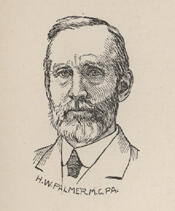
Henry Wilbur Palmer (July 10, 1839 – February 15, 1913) was a Republican member of the U.S. House of Representatives from Pennsylvania who served four terms in Congress between 1901 and 1911. A prominent lawyer and public official, he played an active role in state and national politics during a significant period in American history and was the father of Bradley Palmer, a Boston lawyer known for his involvement with United Fruit Company, Gillette, and ITT Corporation.
Palmer was born in Clifford Township, Susquehanna County, Pennsylvania, on July 10, 1839. He was the son of Gideon Palmer, who had moved from Massachusetts to Pennsylvania in 1836. Raised in northeastern Pennsylvania, he received his early education in the region before pursuing more advanced studies. He attended Wyoming Seminary in Kingston, Pennsylvania, a well-regarded Methodist preparatory school, and later continued his education at Fort Edward Institute in Fort Edward, New York. Demonstrating an early interest in the law, he enrolled at the National Law School in Poughkeepsie, New York, from which he graduated in 1860.
Following his legal studies, Palmer was admitted to the bar in Peekskill, New York, in 1861, and that same year was also admitted to practice in Wilkes-Barre, Pennsylvania, where he would establish his long-term professional and political base. Early in his career he served as a prothonotary’s clerk in 1861, gaining experience in court administration and legal procedure. During the Civil War he entered federal service in the Union Army’s pay department, serving in New Orleans in 1862 and 1863. This work in the military financial administration during wartime added to his experience in public service and fiscal matters.
Palmer’s prominence in Pennsylvania public life grew steadily in the postwar years. He was selected as a member of the Pennsylvania constitutional convention of 1872–1873, which undertook a major revision of the state’s fundamental law. His work in the convention helped establish his reputation as a capable lawyer and constitutional thinker. Building on that reputation, he was appointed and served as attorney general of Pennsylvania from 1879 through 1883, acting as the chief legal officer of the Commonwealth and representing the state in important legal matters during a period of industrial expansion and political change.
A committed member of the Republican Party, Palmer was elected as a Representative from Pennsylvania to the United States Congress at the turn of the twentieth century. He was chosen to the Fifty-seventh, Fifty-eighth, and Fifty-ninth Congresses, serving from 1901 to 1907, and later returned to serve in the Sixty-first Congress, extending his service through 1911. His tenure thus encompassed four terms in the U.S. House of Representatives. During these years he participated in the legislative process at the national level, representing the interests of his Pennsylvania constituents during a significant era that included the early Progressive period and the administration of President Theodore Roosevelt. In 1905 he was appointed one of the managers by the House of Representatives to conduct the impeachment proceedings against Charles Swayne, judge of the United States Court for the Northern District of Florida, a notable responsibility reflecting the confidence of his colleagues in his legal and parliamentary abilities.
Alongside his public career, Palmer’s family life connected him to broader currents of social reform and business development in the United States. In September 1861 he married Ellen Webster, who became known as an important social reformer in the late nineteenth century. Ellen W. Palmer was particularly recognized for her efforts to secure fair pay for breaker boys—young boys employed in the coal industry to separate coal from slate—in Luzerne County, Pennsylvania, a major coal-mining region that included Wilkes-Barre. Together Henry and Ellen Palmer had six children, two sons and four daughters. Their eldest son, Bradley Palmer, rose to prominence as an important Boston lawyer who helped form United Fruit Company, Gillette, and ITT Corporation, served on the boards of these and many other companies, and later represented President Woodrow Wilson at the Paris Peace Conference following World War I.
After concluding his final term in Congress in 1911, Henry Wilbur Palmer returned to his legal practice in Wilkes-Barre, continuing to work as an attorney. He remained active in his profession until his death in that city on February 15, 1913. Palmer was interred in Hollenback Cemetery in Wilkes-Barre, Pennsylvania, closing a career that spanned local, state, and national service during a transformative period in American political and economic history.
Congressional Record