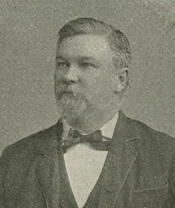
Henry Warren Ogden (October 21, 1842 – July 23, 1905) was an American planter, state legislator, and Democratic member of the United States House of Representatives who represented Louisiana’s 4th congressional district from 1893 to 1899. Over three terms in Congress, he contributed to the legislative process during a significant period in American history, participating in the democratic process and representing the interests of his northwestern Louisiana constituents.
Ogden was born on October 21, 1842, in Abingdon, Washington County, in far southwestern Virginia. In 1851, he moved with his parents to Warrensburg in Johnson County, in west-central Missouri. There he attended the local common schools, receiving a basic formal education typical of mid-19th-century rural communities. His formative years in Missouri, a border state with divided loyalties during the coming sectional crisis, shaped the environment in which he entered adulthood on the eve of the American Civil War.
During the American Civil War, Ogden joined the Confederate States Army, despite residing in Missouri, a state that formally remained in the Union. He served in the Missouri Confederate forces and rose to the rank of first lieutenant. Ogden was first lieutenant of Company D, Sixteenth Regiment, Missouri Infantry, and later served on the staff of Brigadier General Lewis of the Second Brigade, Parsons’ Division, Missouri Infantry. During the conflict he was captured and held as a prisoner of war for approximately one year. On June 8, 1865, following the end of hostilities, he was paroled at Shreveport in Caddo Parish, northwestern Louisiana.
After his parole, Ogden remained in Louisiana, settling in the Red River region. He established himself in adjacent Bossier Parish, where he became a wealthy planter. His success in agriculture and his standing in the community positioned him as a leading local figure during the Reconstruction and post-Reconstruction eras. Through his plantation interests and civic involvement, he gained influence in Bossier Parish and the broader northwestern Louisiana area.
Ogden’s political career began in state-level affairs. In 1879, he served as a member of the Louisiana constitutional convention, participating in the reshaping of the state’s fundamental law during a period of political realignment in the post-Reconstruction South. Subsequently, he was elected to the Louisiana House of Representatives from Bossier Parish. Within the state legislature, he rose quickly in prominence and was chosen Speaker of the Louisiana House of Representatives, serving in that capacity from 1884 to 1888. His speakership marked him as one of the leading Democratic politicians in Louisiana during the late nineteenth century.
Building on his state legislative experience, Ogden entered national politics as a Democrat. He was elected to the United States House of Representatives from Louisiana’s 4th congressional district in a special election held in 1894 to fill the vacancy created by the resignation of Representative Newton C. Blanchard. Ogden took his seat on May 12, 1894, during the Fifty-third Congress. He was subsequently reelected to the Fifty-fourth and Fifty-fifth Congresses, serving continuously from May 12, 1894, to March 3, 1899. Across these three terms in office, he participated in the legislative work of the House of Representatives during a period marked by economic change, regional realignment, and the aftermath of Reconstruction, consistently representing the interests of his Louisiana constituents as a member of the Democratic Party.
At the conclusion of his third term, Ogden left Congress in 1899 and returned to private life in Bossier Parish. He resumed management of his agricultural interests and continued to be identified with the planter class that had long dominated the economic and social life of the region. He lived out his remaining years in northwestern Louisiana, maintaining his ties to the local community he had represented at both the state and national levels.
Henry Warren Ogden died on July 23, 1905, in Benton, the parish seat of Bossier Parish, Louisiana. His career spanned military service in the Confederate Army, prominence as a wealthy planter, leadership in the Louisiana House of Representatives, and three terms in the United States Congress, marking him as a significant political figure in late nineteenth-century Louisiana.
Congressional Record