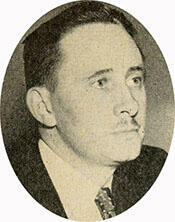
Henry Jepson Latham (December 10, 1908 – June 26, 2002) was an American attorney, politician, and jurist from New York who served as a Republican member of the United States House of Representatives from 1945 to 1958 and later as a Justice of the New York Supreme Court from 1959 to 1978. Over the course of seven consecutive terms in Congress, he contributed to the legislative process during a significant period in American history, representing his New York constituents in the House of Representatives and participating actively in the democratic process.
Latham was born in Brooklyn, New York, on December 10, 1908. He was educated in New York City, graduating from Richmond Hill High School. He then pursued pre-law studies at St. John’s College, laying the groundwork for a legal career. Latham went on to attend Brooklyn Law School, from which he received an LL.B. degree in 1931. Admitted to the bar in 1932, he began practicing law in Jamaica, Queens. Demonstrating a commitment to advanced legal study, he earned an LL.M. from Brooklyn Law School in 1933. In recognition of his professional accomplishments and public service, Brooklyn Law School later awarded him an honorary LL.D. degree in 1960.
Latham’s early political career developed alongside his legal practice. A Republican, he first sought higher office in 1938 as a candidate for the New York State Senate, though he was unsuccessful in that bid. He soon entered state-level legislative service, winning election to the New York State Assembly from Queens County’s 4th District. He served in the Assembly from 1941 to 1942, gaining experience in lawmaking and public affairs that would inform his later federal service.
With the onset of World War II, Latham entered military service. In 1942 he joined the United States Navy, where he trained as a pilot and served in the Pacific Theater. His active duty continued until February 1945, during which time he combined military responsibilities with his emerging political career. After the war, he remained affiliated with the armed forces through continued service in the United States Navy Reserve, reflecting his enduring interest in national defense and military affairs.
Latham’s congressional career began while he was still on active duty. In 1944 he was elected to the United States House of Representatives in absentia as a Republican from New York. He took his seat in the 79th Congress on January 3, 1945, and was subsequently reelected six times, serving in the 79th, 80th, 81st, 82nd, 83rd, 84th, and 85th Congresses. His tenure extended from January 3, 1945, to December 31, 1958, encompassing seven full terms. During these years he represented his New York district through the closing phase of World War II, the early Cold War, and the beginning of the civil rights era. Among his recorded legislative positions, Latham voted in favor of the Civil Rights Act of 1957, supporting one of the first major federal civil rights measures since Reconstruction.
Ideologically, Latham was regarded as a conservative with a strong anti-communist stance. He served on the influential House Committee on Rules, which plays a central role in determining how legislation is considered on the House floor. In keeping with his national security focus, he advocated for increasing the size and capability of the United States Armed Forces. He was also a proponent of providing arms to Taiwan, then commonly referred to as Formosa, to bolster its ability to resist the Communist government of China. Through these positions, Latham aligned himself with a robust Cold War foreign policy and a firm stance against the spread of communism.
At the close of his congressional service, Latham transitioned to a judicial career. In 1959 he became a Justice of the New York Supreme Court, the state’s trial court of general jurisdiction, a position he held until 1978. His nearly two decades on the bench capped a long public career that had spanned legislative, military, and judicial service. His judicial tenure further solidified his reputation as a figure of authority in New York’s legal and political life.
Henry Jepson Latham died on June 26, 2002, in Southold, New York. He was interred at Saint Patrick’s Cemetery in Southold. His career, extending from local legal practice and state legislative service to the United States Congress and the New York Supreme Court, reflected a sustained engagement with public service during some of the most consequential decades of the twentieth century.
Congressional Record