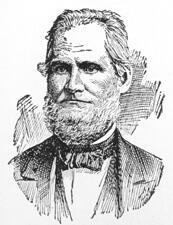
Henry Smith Lane (February 24, 1811 – June 19, 1881) was a United States representative and senator from Indiana and the 13th Governor of Indiana; he was by design the shortest-serving governor of Indiana, having planned in advance to resign the office should his party take control of the Indiana General Assembly and elect him to the United States Senate. He held the governorship for only two days and was widely known for his opposition to slavery. Initially a member of the Whig Party and a supporter of compromise with the South, he became an early leader in the Republican Party starting in 1856, serving as president of the first national party convention, delivering its keynote address, and playing an influential role in the nomination of Abraham Lincoln. With the repeal of the Missouri Compromise, he became a full-fledged abolitionist, and in the Senate he was a pro-Union advocate and a strong supporter of the Civil War effort to defeat the Southern Confederacy.
Lane was born in Bath County, Kentucky, near Sharpsburg, on February 24, 1811, the son of James H. Lane and Mary Higgins Lane. He received a classical education from private tutors and then studied law. He was admitted to the bar at Mount Sterling, Kentucky, in 1832. While still a young man in Kentucky he became an opponent of slavery and a supporter of Henry Clay. At age twenty, in October 1831, he delivered an anti-slavery address before a colonization society, declaring, “The History of all times admonishes us that no man or community of men can be kept forever in slavery.” At this stage he opposed the expansion of slavery but, like Clay, believed that if its spread were checked the institution would gradually die out, and he did not yet favor immediate abolition. In 1833 he married Pamela Bledsoe Jameson. The couple had no children. In 1835 Lane moved to Crawfordsville, Indiana, where he worked for the Bank of Indiana and opened a law office, taking mainly criminal cases. His first wife was killed in a stagecoach accident in 1842, in which Lane himself escaped with only minor injuries.
Soon after settling in Indiana, Lane became active in Whig politics. He represented Montgomery County in the Indiana Senate in 1837 and served in the Indiana House of Representatives from 1838 to 1839. He was elected as a Whig to the U.S. House of Representatives in 1840 to fill the vacancy caused by the resignation of Tilghman A. Howard, won reelection the following year by an overwhelming majority over John Bryce, and served in Congress until 1843. He did not seek reelection to a second full term. During his early congressional service he favored compromise with the South over slavery and openly condemned radical abolitionist agitation as a source of sectional disunity. In the 1844 presidential campaign he stumped much of Indiana on behalf of Henry Clay. In 1845 he married Joanna Maria Elston, daughter of Isaac Compton Elston, a prominent Crawfordsville businessman and major investor in the Bank of Indiana. After the 1844 election Lane returned to his law practice in Crawfordsville, where he remained until the outbreak of the Mexican–American War.
When war with Mexico began, Lane emerged as an ardent supporter of the conflict. In May 1846 he attended a war meeting in Indianapolis, became an active participant, and helped draft resolutions pledging Indiana troops for the invasion of Mexico. He personally raised a company of volunteers and entered service as their commander, rising to the rank of lieutenant colonel of the First Regiment Indiana Infantry. His regiment spent most of the war in Mexico guarding supply lines and military posts and saw relatively little combat. When the regiment’s term of enlistment expired, Lane returned by ship to Madison, Indiana, where he publicly rebuked fellow Whigs who had opposed the war. He then organized another company and returned to Mexico with the Fifth Indiana Regiment Infantry, remaining there for the duration of the conflict. After the war he was the Whig candidate for Congress in 1849 against Joseph E. McDonald; the contest was close, but Lane was defeated and returned to private life. He abandoned the active practice of law and in 1854 entered the banking business in Crawfordsville.
The political upheavals of the 1850s drew Lane back into public affairs. In 1854 he joined the American, or Know Nothing, Party, along with many other disaffected Whigs. In the Indiana legislature he strongly supported sending a Know Nothing candidate to the United States Senate, contributing to a prolonged deadlock in which Democrats, led by Senate president Ashbel Willard, blocked the election of any senator. The confrontation escalated into a notorious episode in which the Know Nothings locked up the entire General Assembly, an affair that damaged the party but brought Lane national attention for his defiance of the Democrats. As the Know Nothings quickly disintegrated, Lane aligned himself with the emerging Republican Party. In 1856 he attended the first Republican National Convention in Philadelphia, where he was elected president of the convention and delivered the keynote address, gaining national recognition for his oratory. Returning to Indiana, he campaigned vigorously for the new party. That year Republicans gained significant strength in the General Assembly and, with support from some Democrats, elected Lane and William McCarty to the U.S. Senate. Lane and McCarty traveled to Washington to challenge the state’s sitting senators, but the U.S. Senate refused to seat them. The repeal of the Missouri Compromise deepened Lane’s hostility to slavery and transformed him from a cautious opponent of its expansion into a committed abolitionist who favored national action against the institution.
Lane’s prominence in the Republican Party led to his selection as the party’s candidate for governor of Indiana in 1860, with Oliver P. Morton as the nominee for lieutenant governor. They faced Democrat Thomas A. Hendricks. Before the election, party leaders negotiated that, if victorious, Lane would be chosen by the legislature for the U.S. Senate and Morton would become governor. Both men canvassed the state extensively. After delivering a major speech in Evansville, Lane attended the second Republican National Convention in Chicago in 1860, where he was influential in securing the presidential nomination for Abraham Lincoln, with whom he enjoyed a friendly relationship; Lincoln is reported to have remarked, “Here comes an uglier man than I am,” when seeing Lane. Returning to Indiana after the convention, Lane held a final debate with Hendricks in Fort Wayne. Although considered less adept in formal debate than his opponent, he was widely regarded as the superior platform orator. He soon refused further joint debates and instead toured the state delivering speeches on his own. In a close election he defeated Hendricks by about 1,000 votes and was inaugurated as the 13th Governor of Indiana on January 14, 1861. In accordance with the prearranged plan, he resigned after only two days in office to accept election to the U.S. Senate, and Morton succeeded him as governor. By design, this made Lane the shortest-serving governor in Indiana’s history.
Henry Smith Lane’s service in Congress occurred during a significant period in American history. A member of the Republican Party, he contributed to the legislative process during three terms in office. After his brief governorship, he was elected by the Republican-controlled Indiana legislature to the United States Senate. Initially, the Democratic-dominated Senate again refused to seat him, as it had in 1856, but as Southern states began to secede from the Union and the Southern Democratic majority collapsed, Lane was finally admitted. He served as a senator from Indiana from March 4, 1861, to March 3, 1867. As a member of the Senate during the Civil War, Lane participated actively in the democratic process and represented the interests of his constituents while strongly supporting President Lincoln’s policies. He was a pro-Union advocate and a vigorous supporter of the war effort to defeat the Confederacy. During his Senate tenure he served as chairman of the Committee on Engrossed Bills in the Thirty-seventh through Thirty-ninth Congresses and as a member of the Committee on Pensions in the Thirty-ninth Congress.
After his Senate term ended in 1867, Lane returned to Crawfordsville and did not again seek or hold elective office. He remained a respected figure in Indiana and continued to receive federal appointments. From 1869 to 1871 he served as a special Indian commissioner, participating in the formulation and oversight of federal Indian policy. President Ulysses S. Grant later appointed him a commissioner for the improvement of the Mississippi River, a position that reflected the continuing confidence of national leaders in his judgment and administrative abilities. In private life he was associated with banking and local civic affairs in Crawfordsville, where he had long been a leading citizen.
On the evening of June 18, 1881, Lane entertained friends at his home in Crawfordsville. After the gathering he experienced severe chest pains and died the following afternoon, June 19, 1881, at about 1 p.m., of an apparent heart attack. His death was reported in newspapers across the country, and memorial observances were held in many places. Lane was buried on June 21, 1881, in a vault at Oak Hill Cemetery in Crawfordsville. His pallbearers included former governors of Indiana and former colleagues from the Senate, and the state later erected a monument over his grave in recognition of his long and varied public service.
Congressional Record