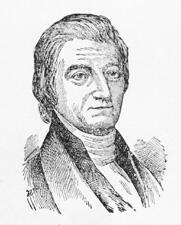
Henry Hubbard (May 3, 1784 – June 5, 1857) was an American lawyer, legislator, and Democratic politician who served as a member of the United States House of Representatives from 1829 to 1835, a United States Senator from New Hampshire from 1835 to 1841, and the 18th governor of New Hampshire from 1842 to 1844. Over the course of his public career he also held numerous local and state offices, including service as Speaker of the New Hampshire House of Representatives and as a county probate judge.
Hubbard was born on May 3, 1784, in Charlestown, New Hampshire. He was educated at home and pursued classical studies under private tutors before entering Dartmouth College. He graduated from Dartmouth in 1803 and then studied law in Portsmouth under the prominent attorney Jeremiah Mason. Around 1806 he was admitted to the New Hampshire bar and that same year began the practice of law in his native Charlestown. In 1813 he married Sally Walker Dean; the couple had five children. In addition to his legal and political pursuits, Hubbard engaged in financial affairs, purchasing 50 shares of the Suffolk Bank, a clearinghouse bank on State Street in Boston, in 1818.
Hubbard’s public service began at the local level. In 1810 he was first elected town moderator of Charlestown, a position to which he would ultimately be chosen sixteen times. He entered the New Hampshire House of Representatives in 1812 and served there from 1812 to 1814, again from 1819 to 1820, and from 1823 to 1827. From 1825 to 1827 he was Speaker of the New Hampshire House. He also served as a selectman of Charlestown in 1819, 1820, and 1828. In addition to his legislative roles, Hubbard held several legal and military posts: he was judge advocate of the 5th Militia Brigade, solicitor for Sullivan County from 1823 to 1828, state solicitor for Cheshire County during the same period, and probate judge for Sullivan County from 1827 until 1829. Early in his political life he was aligned with the Federalist Party, but his views shifted in the 1820s as national politics realigned.
On March 4, 1829, Hubbard entered national office as a member of the United States House of Representatives, elected as a Jacksonian Democrat. He represented New Hampshire in the 21st, 22nd, and 23rd Congresses, serving until March 3, 1835. During the 22nd Congress he was chairman of the Committee on Revolutionary Pensions, overseeing legislation related to benefits for veterans of the American Revolution. In 1834 he was chosen Speaker pro tempore of the House. His service in Congress occurred during a significant period in American history marked by the Jacksonian era’s debates over federal power, banking, and economic policy, and he participated in the legislative process as a member of the Democratic Party, representing the interests of his New Hampshire constituents through four terms in national office when his House and subsequent Senate service are considered together.
Hubbard advanced to the United States Senate as a Democrat and served as a Senator from New Hampshire from March 4, 1835, to March 3, 1841. During the 24th, 25th, and 26th Congresses he was chairman of the Committee on Claims, where he dealt with petitions and financial demands made upon the federal government. His Senate tenure extended his influence in national affairs during the later Jackson and Van Buren administrations, a time of economic upheaval and partisan conflict, and he remained a consistent supporter of Democratic policies until the close of his Senate service in 1841.
After leaving the Senate, Hubbard turned to state executive office. He secured the Democratic nomination for governor of New Hampshire and was elected by popular vote in 1842, becoming the state’s 18th governor. He won reelection in 1843 and served until 1844. As governor, Hubbard favored lowering high national protective tariffs, reflecting his Democratic commitment to reduced trade barriers. He publicly denounced capital punishment and urged reforms in the criminal law. He called for state legislation to curb corporate shareholder profits realized at public expense, expressing concern over the growing power of corporations. He also advocated tax reductions for women who owned property, an early acknowledgment of women’s economic interests within the state’s fiscal system.
In the later phase of his career, Hubbard held a federal financial post as subtreasurer in Boston from 1846 to 1849, administering federal funds at a key regional treasury office. After completing this service, he returned to Charlestown and resumed the practice of law. He lived there until his death on June 5, 1857. Henry Hubbard was interred in Forest Hill Cemetery in Charlestown, New Hampshire, closing a long career that spanned local, state, and national public service.
Congressional Record