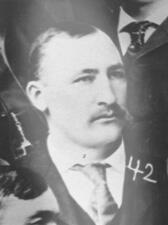
Henry Heitfeld (January 12, 1859 – October 21, 1938) was an American politician who represented Idaho in the United States Senate from 1897 to 1903. Although associated nationally with the Populist Party, he was also identified with the Democratic Party in Idaho and contributed to the legislative process during one term in office. His service in Congress occurred during a significant period in American history at the turn of the twentieth century, when issues of monetary policy, agricultural reform, and western development were central to national debate.
Heitfeld was born in St. Louis, Missouri, where he attended both public and private schools. As a young man he moved westward, first to Seneca, Kansas, then to Pomeroy in Washington Territory, and finally, in 1883, to Lewiston in Idaho Territory. In this developing frontier region he engaged in agricultural pursuits and stock raising, occupations that rooted him in the economic life of the rural West and helped shape his later political identification with agrarian and Populist causes. On November 25, 1884, he married Anna M. Jacobs (1861–1923), originally from Jacobs Prairie, Minnesota, southwest of St. Cloud; the couple made their home in Lewiston.
Following Idaho’s admission to the Union in 1890, Heitfeld became active in state politics. He was elected to the Idaho State Senate and served from 1894 to 1897, participating in the formative legislative years of the new state. His work in the state senate, combined with his prominence as a farmer and stockman, positioned him as a leading figure in Idaho’s Populist movement, which drew support from farmers, laborers, and others dissatisfied with prevailing economic conditions.
In 1896 Heitfeld was elected as a Populist to the United States Senate from Idaho, with support from Democratic allies, and he took his seat in March 1897. He served a single term, from 1897 to 1903, and did not seek reelection in 1902. During his tenure, he participated in the democratic process and represented the interests of his Idaho constituents at a time when the nation was grappling with questions of silver coinage, regulation of corporate power, and the governance of newly acquired territories following the Spanish–American War. As a member of the Senate, Heitfeld contributed to the legislative deliberations of this era and provided a Populist and western perspective on national policy.
After leaving the Senate in 1903, Heitfeld remained active in Idaho politics. He was a candidate for governor in 1904 but was defeated by Republican Frank R. Gooding. The following year he was elected mayor of Lewiston, serving from 1905 to 1909. In this role he oversaw local governance during a period of continued growth and consolidation in the city that had long been his home. His mayoral service reflected his continued commitment to public life and to the civic development of Lewiston.
Heitfeld later entered federal administrative service. From 1914 to 1922 he served as registrar of the United States General Land Office at Lewiston, a position of particular importance in a region where land disposition, homesteading, and resource management were central public issues. During this period he also engaged in fruit growing, continuing his long-standing involvement in agriculture. Even in later life he returned to elective office: at age seventy-one, in 1930, he was elected to the Nez Perce County Commission, eventually serving as its chair. He remained in that role until shortly before his retirement in 1938.
In 1938 Heitfeld retired from public life and moved to Spokane, Washington. He died there on October 21, 1938. At the time of his death he was noted as the last living former United States senator to have served in the nineteenth century, marking the passing of a political generation that had bridged the frontier and progressive eras. His funeral was held in Lewiston at St. Stanislaus Catholic Church, and he was buried in Normal Hill Cemetery beside his wife, Anna, closing a life closely intertwined with the political and civic development of Idaho and the inland Northwest.
Congressional Record