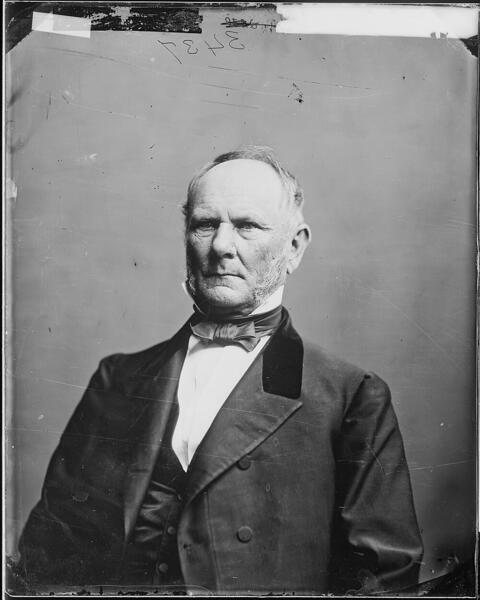
Henry Grider (July 16, 1796 – September 7, 1866) was a United States Representative from Kentucky who served in Congress before and during the Civil War and participated in the early legislative efforts of Reconstruction. He was born in Garrard County, Kentucky, where he spent his early years in the agrarian society of the early republic. Details of his family background are sparse in the historical record, but his subsequent public career suggests an upbringing that afforded him access to education and to the legal profession at a time when Kentucky was transitioning from frontier conditions to a more settled political and economic life.
Grider pursued an academic course in his youth, a term commonly used in the period to denote a classical or college-preparatory education rather than purely vocational training. He then studied law, following the customary practice of reading law under established attorneys rather than attending a formal law school, which was still uncommon in the early nineteenth century. After completing his legal studies, he was admitted to the bar and commenced the practice of law in Bowling Green, Kentucky. Bowling Green, located in Warren County, was an emerging regional center, and Grider’s establishment there as a lawyer placed him within a growing professional class that often supplied candidates for public office.
During the War of 1812, Grider served in the United States forces, participating in the conflict that shaped the political consciousness of many future leaders of his generation. Although detailed records of his specific unit or engagements are not widely documented, his service in the war aligned him with the wave of younger politicians whose early military experience underpinned their later claims to public trust. After the war, he resumed his legal practice in Bowling Green and began to build a local reputation that would support his entry into state politics.
Grider’s formal political career began in the Kentucky General Assembly. He was elected to the Kentucky House of Representatives, serving in 1827 and again in 1831. In these years, Kentucky politics were marked by debates over internal improvements, banking, and the legacy of the “Old Court–New Court” controversy, and service in the state legislature provided him with experience in legislative procedure and party organization. He advanced to the upper chamber of the state legislature as a member of the Kentucky Senate, in which he served from 1833 to 1837. His tenure in the Senate coincided with the ascendancy of the Whig Party in Kentucky, a state that was a stronghold of Henry Clay and Whig economic and constitutional ideas.
Building on his state legislative experience, Grider was elected as a Whig to the United States House of Representatives, representing Kentucky in the Twenty-eighth and Twenty-ninth Congresses from March 4, 1843, to March 3, 1847. His service in these pre–Civil War Congresses placed him in the midst of national debates over tariffs, banking, and territorial expansion, including the period of the Mexican-American War. Although the detailed record of his committee assignments and floor speeches from this era is limited in surviving summaries, his affiliation with the Whig Party suggests alignment with its general support for internal improvements and a cautious approach to territorial expansion that might exacerbate sectional tensions over slavery.
After leaving Congress in 1847, Grider returned to Kentucky and resumed his legal practice in Bowling Green. During the 1850s, as the Whig Party fractured under the strain of sectional conflict, Kentucky politicians were forced to navigate shifting party allegiances and the rise of new political formations. Grider, like many border-state Whigs, moved through these realignments while maintaining a Unionist outlook that would shape his later congressional service. He remained a figure of local and regional prominence, and his experience and reputation positioned him for a return to national office as the country moved toward civil war.
With the secession crisis and the outbreak of the Civil War, Grider reentered national politics. He was elected as a Unionist to the Thirty-seventh and Thirty-eighth Congresses and then as a Democrat to the Thirty-ninth Congress, serving continuously from March 4, 1861, until his death on September 7, 1866. Representing a loyal but deeply divided border state, he occupied a complex political position, supporting the preservation of the Union while often differing with the Republican majority on questions of emancipation and the scope of federal authority. His vote on the Thirteenth Amendment to the United States Constitution, which abolished slavery, is recorded as “nay,” reflecting the conservative and pro-slavery sentiment that persisted among many Kentucky Unionists even as they opposed secession.
During his final term, in the immediate aftermath of the Civil War, Grider played a direct role in shaping the early legislative framework of Reconstruction. He served on the Joint Committee on Reconstruction, the powerful congressional body charged with investigating the conditions in the former Confederate states and recommending measures for their readmission to the Union. This committee drafted the Fourteenth Amendment to the United States Constitution, which defined national citizenship and sought to secure civil rights for formerly enslaved people. Grider’s participation on this committee placed him at the center of one of the most consequential constitutional debates of the nineteenth century, even as his overall voting record reflected the tensions and contradictions of border-state Unionism.
Henry Grider died in office in Bowling Green, Kentucky, on September 7, 1866, while still serving in the Thirty-ninth Congress. His death came at a moment when the nation was deeply engaged in the struggle over Reconstruction policy and the balance of power between Congress and the presidency. He was buried in Old College Street Cemetery in Bowling Green, a resting place that reflects his long association with the city where he had practiced law, built his political career, and represented his constituents over multiple decades of profound national change.
Congressional Record