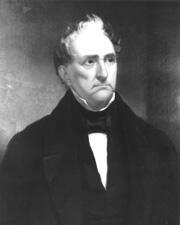
Henry Waggaman Edwards (October 1779 – July 22, 1847) was an American lawyer, Democratic politician, and a member of the Jackson Party who served as a United States Representative and Senator from Connecticut and later as the 27th and 29th governor of Connecticut. He was a cousin of Aaron Burr (1756–1836), the third vice president of the United States, a family connection that placed him in proximity to some of the most prominent political figures of the early republic.
Born in October 1779, Edwards came of age in the formative years of the United States, when the new nation’s political institutions and party alignments were still taking shape. Details of his early life and schooling are sparse in the surviving record, but he pursued the study of law, a common path for ambitious young men seeking public careers in the early nineteenth century. His legal training prepared him for both private practice and eventual service in public office, and he established himself sufficiently in his profession to enter politics from a position of local standing and respect.
Edwards’s formal education culminated in his admission to the bar, after which he began practicing law. As an attorney, he would have been engaged with the legal and commercial issues of a rapidly developing New England, gaining experience in statutory interpretation and public affairs that would later inform his legislative work. His family ties to Aaron Burr and his own professional advancement helped introduce him to the broader political networks of his era, aligning him with the emerging Democratic and Jacksonian movements that challenged the older Federalist and National Republican establishments.
Edwards entered national politics as a member of the United States House of Representatives from Connecticut, serving from 1819 to 1823. His service in the House coincided with the so‑called “Era of Good Feelings,” a period marked by the decline of the Federalist Party and the dominance of the Democratic-Republicans, as well as by debates over internal improvements, tariffs, and the extension of slavery into new territories. As a Representative, he participated in the legislative process and represented the interests of his Connecticut constituents at a time when the nation was grappling with questions of economic development and sectional balance.
In 1823, Edwards moved to the upper chamber of Congress, beginning his tenure as a United States Senator from Connecticut. He served in the Senate from 1823 to 1827, a span that is sometimes described as three terms in office in the sense of successive periods of federal legislative service beginning with his election to the House in 1819 and continuing through his Senate years. As a member of the Senate during a significant period in American history, he took part in the democratic process at a national level, contributing to debates over federal authority, economic policy, and the evolving party system. Identified with the Jackson Party and later the Democratic Party, he aligned himself with the populist and states’ rights currents that were coalescing around Andrew Jackson and that would soon reshape the nation’s political landscape.
After leaving the Senate in 1827, Edwards continued his political career in Connecticut, emerging as a leading Democrat in the state. He was elected governor of Connecticut and served two nonconsecutive periods as the state’s chief executive, first from 1833 to 1834 as the 27th governor and again from 1835 to 1838 as the 29th governor. His gubernatorial terms coincided with the Jacksonian era in national politics, when issues such as banking policy, the role of corporations, and the expansion of suffrage were vigorously contested. As governor, Edwards oversaw state governance during a time of economic and political change, working within the Democratic framework to address Connecticut’s internal improvements, fiscal policy, and the adjustment of state institutions to the broader currents of Jacksonian democracy.
In his later years, Edwards remained a figure associated with the Democratic and Jacksonian traditions in Connecticut, his career reflecting the transition from the early republic’s fluid party alignments to the more structured two‑party system of Democrats and Whigs. He died on July 22, 1847, closing a public life that had spanned service in both houses of Congress and the governorship of his state. His long career in law and politics, together with his family connection to Aaron Burr, placed him within the broader narrative of the United States’ political development in the first half of the nineteenth century.
Congressional Record