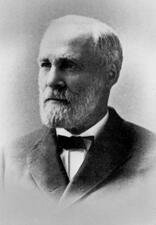
Henry Laurens Dawes (October 30, 1816 – February 5, 1903) was an American attorney and Republican politician who served as a United States representative and United States senator from Massachusetts. Best known as the author of the Dawes Act of 1887, he played a central role in federal Indian policy in the late nineteenth century and was a prominent figure in congressional debates over slavery, Reconstruction, tariffs, and civil service reform. His service in Congress, including his tenure as a senator from Massachusetts from 1857 to 1893 as reflected in contemporary accounts, spanned a significant period in American history and contributed to the legislative process during twelve terms in office.
Dawes was born in Cummington, Massachusetts, on October 30, 1816. He was educated in local schools before attending Yale University, from which he graduated in 1839. After college he taught school in Greenfield, Massachusetts, and edited The Greenfield Gazette, marking an early engagement with both education and public discourse. He subsequently studied law with an established firm and was admitted to the bar in 1842. Dawes began the practice of law in the village of North Adams, Massachusetts, where he also, for a time, edited The North Adams Transcript, further cementing his role as a local civic and intellectual leader.
Dawes’s political career began in Massachusetts state government. After aligning with the emerging Republican Party, he was elected to the Massachusetts House of Representatives, serving in 1848–1849 and again in 1852. He served in the Massachusetts Senate in 1850 and was chosen as a delegate to the Massachusetts Constitutional Convention of 1853, which considered revisions to the state’s fundamental law. From 1853 to 1857 he served as the appointed state district attorney for the western district of Massachusetts, gaining prosecutorial and administrative experience that helped prepare him for national office.
In 1856 Dawes was elected to the United States House of Representatives, where he served multiple terms until 1875. During his long period of legislative activity in the House, he sat on the Committees on Elections, Ways and Means, and Appropriations. He took a prominent part in the passage of anti-slavery and Reconstruction measures during and after the Civil War, in tariff legislation, and in the establishment of a federal fish commission. He also initiated the production of daily weather reports by the federal government, an innovation that laid foundations for modern weather services. In 1868 he received 2,000 shares of stock in the Crédit Mobilier of America railroad construction company from Representative Oakes Ames as part of the Union Pacific Railway’s influence-buying efforts, an episode that later figured in the broader Crédit Mobilier scandal. Beyond these controversies, Dawes was active in supporting scientific exploration: in March 1871 he backed federal financing for Ferdinand Vandeveer Hayden’s fifth geological survey of the territories, a driving force in the creation of Yellowstone National Park. His son, Chester Dawes, served on the survey team, and Annie, the first commercial boat on Yellowstone Lake, was purportedly named after his daughter, Anna Dawes. In late 1871 and early 1872 he became an ardent supporter of legislation to create Yellowstone National Park in order to preserve its wilderness and resources. In 1869 he was also a founding member of the Monday Evening Club, a men’s literary society in Pittsfield, Massachusetts, reflecting his continued interest in intellectual and civic life.
In 1875 the Massachusetts legislature, which then elected U.S. senators, chose Dawes to succeed William B. Washburn in the United States Senate. He served multiple terms in the Senate, with his service recorded as extending to 1893, and during this period he participated actively in the democratic process and represented the interests of his Massachusetts constituents. Within the Republican Party, Dawes emerged as a leading member of the “Half-Breed” faction, which supported civil service reform and was closely allied with President Rutherford B. Hayes during his administration from 1877 to 1881. Along with fellow Massachusetts senator George F. Hoar and Representative John Davis Long, Dawes became one of the Half-Breeds’ principal strategists. During the 1880 Republican National Convention, the Half-Breeds sought to block the nomination of both former president Ulysses S. Grant, leader of the “Stalwarts,” and James G. Blaine of Maine, head of a rival faction, instead promoting Senator George F. Edmunds of Vermont. Although the Massachusetts delegation supported Edmunds, he failed to gain sufficient backing, and the Half-Breeds ultimately allied with Blaine’s supporters to secure the nomination of James A. Garfield of Ohio. When Garfield became president and appointed Blaine as secretary of state, Dawes and Hoar accepted Blaine as a member of the reform faction, though Edmunds refused to regard him as a genuine convert and later declined to support Blaine’s presidential candidacy in 1884. Throughout this period Dawes consistently supported civil service reform and, during Garfield’s presidency, wrote multiple letters in July 1881 advocating such measures.
As a senator, Dawes rose to particular prominence as chairman of the Committee on Indian Affairs. In the decades following the Indian Wars, when many Americans feared that Native peoples and their tribal structures were on the verge of disappearance, Dawes was among those who believed that survival required assimilation into the dominant agrarian culture. He and like-minded reformers argued that Native Americans should adopt subsistence farming, then still widespread in American society, and that tribal communal landholding and governance should be dismantled. This outlook culminated in the General Allotment Act of 1887, widely known as the Dawes Act. Intended to stimulate the assimilation of Native Americans by ending tribal government and communal control of lands, the Act provided for the allotment of tribal lands to individual households of tribal members and granted them United States citizenship, thereby making them subject to state and federal taxes. The law was especially directed at tribes in Indian Territory and, by extinguishing tribal land claims there, later facilitated the admission of Oklahoma as a state in 1907. The Act was amended in 1891, again in 1898 by the Curtis Act, and again in 1906 by the Burke Act, each change further shaping federal Indian policy.
After leaving the Senate in 1893, Dawes continued to influence Indian affairs as chairman of the Commission to the Five Civilized Tribes, commonly known as the Dawes Commission, a body created under an Indian Office appropriation bill that year. He served in this capacity for ten years. The commission was not established to administer the Dawes Act directly, but rather to persuade tribes that had been excluded from its provisions by treaty to accept the allotment plan. After securing agreements from representatives of the Five Civilized Tribes in Indian Territory, the commission appointed registrars to compile rolls of tribal members prior to the allotment of lands. These “Dawes Rolls” later became the basis for determining membership and citizenship in many tribes and also listed freedmen of each tribe and intermarried whites. The broader consequences of the allotment policy were severe: over the life of the Dawes Act, Native American tribes lost about 90 million acres of treaty land—approximately two-thirds of their 1887 land base—and about 90,000 Native people were rendered landless. Forced onto small, scattered tracts of land, often distant from kin networks, many Native communities saw their land base depleted and hunting as a means of subsistence effectively ended, creating a profound economic and social crisis. The long-term effects of these policies were later documented in the Meriam Report, commissioned by the Coolidge administration and completed in 1928, which concluded that the Dawes Act had been used illegally in many instances to deprive Native Americans of their land rights.
Henry Laurens Dawes spent his later years in Pittsfield, Massachusetts, where he remained a respected elder statesman and participant in civic and intellectual life. He died in Pittsfield on February 5, 1903. His complex legacy, particularly in relation to Native American policy, has continued to attract historical scrutiny. In modern popular culture, he was portrayed by actor Aidan Quinn in the film “Bury My Heart at Wounded Knee,” adapted from Dee Brown’s 1970 history of Native Americans, the United States, and the West, underscoring his enduring association with one of the most consequential pieces of legislation in the history of federal Indian policy.
Congressional Record