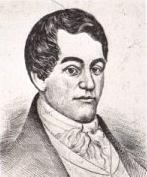
Henry Wharton Conway (March 18, 1793 – November 9, 1827) was a United States naval officer during the War of 1812 and a prominent politician in Arkansas Territory, who was elected as a territorial delegate to the United States House of Representatives for three consecutive Congresses from 1823 to 1827. He emerged as an influential figure in the early political development of Arkansas and died in 1827 as a result of wounds sustained in a duel with Robert Crittenden, a former friend and political ally.
Conway was born into a planter family on March 18, 1793, in Greene County, Tennessee, the son of Thomas Conway and Ann (née Rector) Conway. Raised in a household of some means, he was educated by private tutors rather than in formal public institutions, a common practice among Southern planter families of the period. He was part of a politically ambitious family network that would later become deeply involved in the public life of Arkansas and the broader trans-Mississippi West. Two of his younger brothers, James Sevier Conway and Elias Nelson Conway, followed him westward and into politics, eventually serving as the first and fifth governors of the State of Arkansas, respectively.
During the War of 1812, Conway entered national service in the United States Navy. He was commissioned as an ensign and, demonstrating competence and reliability, was promoted to lieutenant in 1813. His naval service placed him within the expanding military establishment of the young republic during a formative conflict that helped solidify American sovereignty and maritime standing. After the war, in 1817, Conway accepted a civilian position as a clerk in the United States Treasury Department in Washington, D.C., gaining experience in federal administration and finance that would later inform his work as a territorial official and congressional delegate.
Having saved sufficient funds to pursue opportunities in the West, Conway joined the migration to the Missouri Territory in 1818, part of the broader movement of Americans into the trans-Mississippi frontier following the Louisiana Purchase. In 1820, he moved farther south into the newly organized Arkansas Territory, where he quickly became active in territorial affairs. That same year, he was appointed receiver of public moneys, serving in that capacity from 1820 through 1821. In this role he was responsible for handling federal land revenues, a critical function in a frontier territory where land sales and settlement patterns shaped political and economic development. During this period, Conway formed a close political and personal alliance with Robert Crittenden, the influential territorial secretary who often acted as de facto leader in Arkansas politics.
Conway’s growing prominence led to his election in 1822 as the territorial delegate to the Eighteenth Congress. As a member of the Unknown Party representing Arkansas, he contributed to the legislative process during three terms in office. He was re-elected to the Nineteenth and Twentieth Congresses and served continuously from March 4, 1823, until his death on November 9, 1827. As a non-voting delegate, he represented the interests of the Arkansas Territory in the United States House of Representatives during a significant period in American history, advocating for the needs of a developing frontier region in matters such as infrastructure, land policy, and territorial governance. His service in Congress occurred during a time of national expansion and political realignment, and he participated in the democratic process on behalf of his constituents as Arkansas moved gradually toward eventual statehood.
By the mid-1820s, political differences began to strain Conway’s once-close relationship with Robert Crittenden. In 1825, their alliance deteriorated amid disputes over territorial leadership, patronage, and policy, and the former friends became bitter rivals. Their conflict, emblematic of the intense personal and factional politics of frontier territories, soon spilled into the public sphere. Both men used the press to attack one another, publicizing their feud in newspapers and deepening the political and personal animosity between them.
The long-simmering dispute culminated in a formal duel on October 29, 1827, near Napoleon, Arkansas Territory, a settlement at the confluence of the Arkansas and Mississippi Rivers. In accordance with the prevailing code of honor among Southern and frontier elites, Conway and Crittenden met with pistols to settle their differences. Conway was mortally wounded in the encounter and succumbed to his injuries several days later, on November 9, 1827, while still serving as Arkansas’s territorial delegate to Congress. He was interred at Scull Cemetery at Arkansas Post, Arkansas, one of the earliest European-established settlements in the region. In recognition of his role in the territory’s early political life, Conway County, Arkansas, was later named in his honor. His death placed him among the members of the United States Congress who died in office in the nineteenth century and among those killed or wounded while serving, and it marked a dramatic and violent turning point in the political history of early Arkansas.
Congressional Record