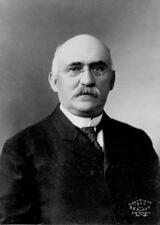
Henry Eben Burnham (November 8, 1844 – February 8, 1917) was a United States senator from New Hampshire and a member of the Republican Party who served two terms in the U.S. Senate from 1901 to 1913. His congressional service occurred during a significant period in American history, and he participated actively in the legislative process while representing the interests of his New Hampshire constituents.
Burnham was born in Dunbarton, Merrimack County, New Hampshire, on November 8, 1844. He was educated in the public schools of the state and at Kimball Union Academy in Meriden, New Hampshire, an institution that prepared many young men for collegiate study and public life. He later attended Dartmouth College in Hanover, New Hampshire, from which he graduated in 1865. Following his graduation, he pursued legal studies, preparing for a professional career in law and public affairs.
After completing his legal training, Burnham was admitted to the bar in 1868 and commenced the practice of law in Manchester, New Hampshire, which would remain his principal residence and professional base. In addition to his legal practice, he engaged in banking and insurance, activities that broadened his experience in financial and commercial matters. His growing prominence in local affairs led to a series of public offices at the county and state levels, reflecting both his legal expertise and his standing within the Republican Party.
Burnham’s early political career included service in the New Hampshire House of Representatives from 1873 to 1874. He was treasurer of Hillsborough County from 1875 to 1877, overseeing county finances, and simultaneously served as judge of probate for Hillsborough County from 1876 to 1879, administering matters related to estates and guardianships. He continued to play a role in state governance as a member of the New Hampshire constitutional convention of 1889, contributing to the revision of the state’s fundamental law. Within the Republican Party, he was chairman of the Republican State convention in 1888, a position that underscored his influence in party organization and strategy, and he later served as a ballot-law commissioner from 1892 to 1900, helping to oversee and regulate electoral procedures in the state.
In 1901 Burnham was elected as a Republican to the United States Senate from New Hampshire. He entered the Senate on March 4, 1901, at the outset of the Fifty-seventh Congress, and was reelected in 1907, serving continuously until March 3, 1913. Over the course of his two terms, he contributed to the legislative process during a transformative era marked by the Progressive movement, debates over regulation of commerce and finance, and expanding American involvement in international affairs. As a senator, he represented New Hampshire’s interests in national policy while aligning with the broader priorities of the Republican Party of his time.
During his Senate career, Burnham held several important committee assignments. He served as chairman of the Committee on Cuban Relations during the Fifty-eighth through Sixtieth Congresses, a role that placed him at the center of congressional oversight of U.S. policy toward Cuba in the years following the Spanish–American War and the establishment of Cuban independence under close American influence. He was also a member of the Committee on Claims in the Sixty-first Congress, dealing with private claims against the federal government, and served on the Committee on Agriculture and Forestry in the Sixty-second Congress, participating in deliberations affecting the nation’s agricultural and natural resource policies. Choosing not to be a candidate for reelection, he concluded his Senate service at the end of his second term in March 1913.
Following his departure from the Senate, Burnham returned to Manchester and resumed the practice of law, remaining engaged in professional and civic life. He was married to Hannah Elizabeth Patterson, with whom he shared his long residence in New Hampshire. Henry Eben Burnham died in Manchester on February 8, 1917. He was interred in Pine Grove Cemetery in that city, closing a career that spanned local, state, and national service over more than four decades.
Congressional Record