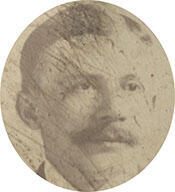
Henry Burk (September 26, 1850 – December 5, 1903) was a Republican member of the U.S. House of Representatives from Pennsylvania and a prominent Philadelphia businessman. He served as a Representative from Pennsylvania in the United States Congress from 1901 until his death in 1903, contributing to the legislative process during two terms in office. His service in Congress occurred during a significant period in American history, and as a member of the House of Representatives he participated in the democratic process and represented the interests of his constituents.
Burk was born on September 26, 1850, in Knittlingen, in the Kingdom of Württemberg, the fourth child of David Burk and his first wife, Louisa Klotzenbacher Burk. His father, a shoemaker, decided to leave Germany because of his unacceptable political views. After Louisa’s death, David married Charlotte Reinmann Burk, and with her he obtained permission from the Württemberg authorities for the family to emigrate. In 1854 they left Germany and settled in Philadelphia, Pennsylvania, where Henry spent the remainder of his life. He attended school for only a few years before going to work to help support his family, and from an early age he was reputed to possess a natural engineering ability.
As a young man in Philadelphia, Burk became a repairer of shoemaking machinery and then advanced into supplying such machinery to the trade. He subsequently entered the manufacture of leather, a field in which he would make his greatest business mark. In 1887 he invented the alum and sumac tawing process, which revolutionized the tanning industry by improving efficiency and product quality. Together with his brothers Alfred E. Burk and Charles D. Burk, he founded Burk Brothers and Company, a leather manufacturing firm that became a major industrial concern in Philadelphia; the company’s facilities are now listed as a Registered Historic Place. He also helped establish a meat-packing enterprise in Philadelphia with the same brothers and two others, William and Louis, which operated under the names Burk Meats and Louis Burk & Co. The firm’s products, marketed as “Burk’s Franks,” became well known throughout the Delaware Valley well into the 1950s. His prominence in industry led to his election as president of the Manufacturers’ National Association in 1895. In connection with his leather business he traveled widely, visiting Europe—including a return to his birthplace in 1894—as well as India and other parts of the world.
On August 18, 1873, in Philadelphia, Burk married Ellen Carney (1851–1914). The couple had six children: Mary, Charles Henry, Henry Jr., Helen, Gertrude, and Charlotte. Through his daughter or son, he became the grandfather of character actor Henry Jones (1912–1999) and the great-grandfather of actress Jocelyn Jones, linking his family to later generations of American performing arts.
Burk entered national politics as a member of the Republican Party. He was originally elected in 1901 as a Republican to the Fifty-seventh Congress, representing Pennsylvania, and he continued in office into the Fifty-eighth Congress until his death. During his tenure in Congress, the Second Boer War was raging in South Africa, and Burk took a notable interest in foreign affairs related to that conflict. He supported the Boer cause against the British and, in response to the United States’ sale of preserved meat, hay, mules, and other supplies to Britain, he moved in the House that “mules, remounts, and other supplies be declared contraband.” By the time this motion was advanced, however, the war was practically over, and his effort did not alter the course of events. Nonetheless, his position illustrated his willingness to challenge prevailing policies and to use his legislative role to express his convictions. Throughout his time in office, he remained aligned with Republican economic and industrial policies, reflecting his background as a manufacturer and business leader.
Henry Burk died in office on December 5, 1903, in Philadelphia, Pennsylvania, while still serving as a member of the U.S. House of Representatives. He was interred at Holy Sepulchre Cemetery in Cheltenham Township, Pennsylvania. His death placed him among the members of the United States Congress who died in office in the early twentieth century, and his colleagues later honored his memory in memorial addresses delivered in the House of Representatives and the Senate, published in 1905.
Congressional Record