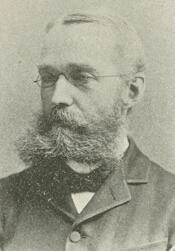
Henry Colvin Brewster (September 7, 1845 – January 29, 1928) was an American politician, banker, and civic leader who served as a Republican Representative from New York in the United States Congress from 1895 to 1899. Over the course of two terms in the House of Representatives, he contributed to the legislative process during a significant period in American history, representing the interests of his constituents in New York’s thirty-first congressional district.
Brewster was born in Rochester, New York, on September 7, 1845, the son of Simon Latham Brewster and Editha Chloe Colvin Brewster. He was educated in the public schools of Rochester, receiving the basic education that prepared him for a career in finance and public life. On October 5, 1876, he married Alice Elizabeth Chapin, establishing a family life in the community where he had been raised and where he would build his professional and political reputation.
Brewster began his banking career at a young age. In 1863 he entered the Traders’ National Bank of Rochester as a clerk, marking the start of a long association with that institution. Demonstrating competence and reliability, he advanced to the position of cashier in 1868, a role he held until 1894. His responsibilities as cashier placed him at the center of the bank’s daily operations during a period of post–Civil War economic expansion and industrial growth in New York. His prominence in local banking also led him into broader financial and commercial circles, and he became one of the organizers of the New York State Bankers’ Association. Within that organization he served as vice president in 1894 and later as president in 1899, reflecting his stature among banking professionals in the state.
In addition to his banking work, Brewster was active in civic and political organizations. He served as vice president of the New York State League of Republican Clubs and as president of the Monroe County League, roles that placed him at the forefront of party organization and political mobilization in upstate New York. He was also a leading figure in the business community, serving as president of the Rochester Chamber of Commerce in 1893 and again in 1902. His involvement in these organizations underscored his influence in both commercial affairs and Republican Party politics at the local and state levels, and helped pave the way for his election to national office.
Elected as a Republican to the Fifty-fourth and Fifty-fifth Congresses, Brewster served as United States Representative for New York’s thirty-first district from March 4, 1895, to March 3, 1899. His service in Congress coincided with a transformative era in American history marked by rapid industrialization, growing urbanization, and increasing national involvement in international affairs. As a member of the House of Representatives, he participated in the democratic process and represented the interests of his constituents from western New York. During the Fifty-fifth Congress he served as chairman of the Committee on Alcoholic Liquor Traffic, a position that placed him at the center of legislative deliberations on issues related to the regulation of alcoholic beverages, an area of growing public concern in the late nineteenth century. He chose not to be a candidate for renomination in 1898, concluding his congressional service after two terms.
After leaving Congress, Brewster returned to his banking and business pursuits while remaining engaged in Republican politics. In 1897 he served as vice president of the National League of Republican Clubs, extending his influence beyond New York to the national party organization. He was a delegate to the Republican National Convention in 1900, participating in the nomination process at a time when the party was consolidating its national dominance. In the financial sector, he continued to advance, becoming president of the Traders’ National Bank in 1907 and serving in that capacity until 1917. When the Consolidated National Bank of New York was organized on July 1, 1902, he was among the fourteen directors, serving alongside figures such as John W. Griggs, George Crocker, Mortimer H. Wagar, and Perry Belmont, which further reflected his standing in national financial circles.
In the later phase of his career, Brewster transitioned from executive to oversight roles in banking. From 1917 to 1923 he served as chairman of the board of the Traders’ National Bank, guiding the institution through the World War I era and the immediate postwar years. He retired from active business in 1923, closing a professional life that had spanned six decades in finance and public affairs. His retirement years were spent in upstate New York, where he had long been a prominent figure in civic, commercial, and political life.
Henry Colvin Brewster died in Canandaigua, New York, on January 29, 1928, at the age of 82. He was interred in Mount Hope Cemetery in Rochester, New York, the city of his birth and the center of much of his professional and political activity. His career combined sustained leadership in banking and commerce with significant service in Republican Party organizations and two terms in the United States House of Representatives.
Congressional Record