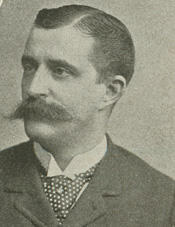
Harry Welles Rusk (October 17, 1852 – January 28, 1926) was a Democratic member of the United States House of Representatives from Maryland who served six consecutive terms in Congress from 1885 to 1897. Representing Maryland’s third congressional district, he participated actively in the legislative process during a period of significant political, economic, and social change in the late nineteenth century. In addition to his political career, he was known in the business community as president of the Kennard Novelty Company of Baltimore, the first company to commercially sell ouija boards in 1890.
Rusk was born on October 17, 1852, and came of age during the tumultuous years surrounding the Civil War and Reconstruction, experiences that helped shape the political environment in which he later served. He pursued his education in Maryland, studying law and preparing for a professional career at a time when the state was rebuilding its economy and political institutions. After completing his legal studies and being admitted to the bar, he began practicing law, establishing himself in Baltimore’s legal and civic circles. His early professional life provided him with a grounding in the legal and constitutional issues that would later inform his work in public office.
As his legal practice developed, Rusk became increasingly involved in Democratic Party politics in Maryland. He emerged as part of a generation of post–Civil War Democrats who sought to reassert their party’s influence in both state and national affairs. His work as an attorney and his engagement with local issues in Baltimore helped build the reputation and connections that led to his election to Congress. By the mid-1880s, he had become a recognized figure in Maryland political life, positioned to represent the interests of an urban, industrializing district.
Rusk was elected as a Democrat to the United States House of Representatives from Maryland’s third district and served six terms, from 1885 to 1897. During these twelve years in Congress, he represented his Baltimore-area constituents in an era marked by debates over tariffs, monetary policy, labor unrest, and the regulation of interstate commerce. As a member of the House of Representatives, he participated in the democratic process and contributed to the legislative work of the chamber, aligning with his party on key issues of the day and helping to articulate the concerns of a growing urban constituency. His long tenure reflected sustained support from voters in his district and continuity of representation during a period of rapid national change.
After leaving Congress in 1897, Rusk continued to be active in professional and business pursuits in Baltimore. Most notably, he served as president of the Kennard Novelty Company, a Baltimore enterprise that gained national attention as the first company to commercially market ouija boards in 1890. Under his leadership, the firm became associated with one of the most recognizable novelty items of the late nineteenth and early twentieth centuries, illustrating his role not only in public life but also in the emerging world of commercial entertainment and popular culture. He maintained his ties to the city’s legal, business, and civic communities during his later years.
Rusk’s family life also reflected connections to national service and international society. His son, Harry Welles Rusk Jr. (1885–1937), served as a Commander in the United States Navy, continuing the family’s tradition of public service in a military capacity. In 1915, Harry Welles Rusk Jr. married Margaret Britton, the youngest daughter of Alexander B. Britton. Through this marriage, the family became linked to European nobility, as Margaret’s elder sister, Catherine, had married Prince Alfred of Hohenlohe-Schillingsfürst, the eldest son of Prince Konrad of Hohenlohe-Schillingsfürst and Countess Franziska von Schönborn-Buchheim.
Harry Welles Rusk remained a prominent figure in Baltimore until his death. He died in Baltimore on January 28, 1926, closing a life that had spanned from the antebellum era through World War I and into the modern age. He was interred in Green Mount Cemetery in Baltimore, a resting place for many of the city’s notable citizens, reflecting his long-standing association with the city he had represented and served in both public office and private enterprise.
Congressional Record