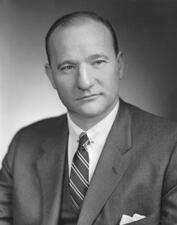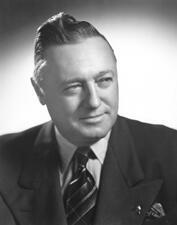
Harry Darby (January 23, 1895 – January 17, 1987) was an American businessman and Republican politician from Kansas who served as a United States Senator from 1949 to 1951. Born in Kansas City, Kansas, he came of age in the early twentieth century in a region that would remain the center of his personal, business, and political life. His early years in Kansas City laid the foundation for a career that would span military service, industrial enterprise, party leadership, and a brief but notable tenure in the United States Senate representing the interests of his Kansas constituents.
Darby pursued higher education at the University of Illinois, from which he graduated before the United States entered World War I. With the nation’s mobilization for war, he entered the United States Army and served during World War I, rising to the rank of captain. His wartime experience provided him with leadership skills and organizational discipline that would later characterize both his business ventures and his public service.
Following the war, Darby returned to civilian life and embarked on a series of successful business enterprises. Based in Kansas City, Kansas, he became active in several sectors, including insurance, steel, railroads, utilities, and banking. From 1933 to 1937 he served on the Kansas State Highway Commission, gaining his first significant experience in public administration and state-level infrastructure policy. In 1938, as owner of the Darby Steel Company, he purchased the Kaw Steel Construction Company in the West Bottoms district of Kansas City, Kansas, and merged the two to form The Darby Corporation. During World War II, this plant became a major producer of landing craft tanks (LCTs) and landing craft mechanized (LCMs) used in amphibious invasions. The facility, located at the mouth of the Kansas River, could hold eight 135-foot LCTs and sixteen LCMs in various stages of construction, and it built roughly one LCT per day, sending them more than 1,000 miles down the Missouri and Mississippi Rivers to New Orleans, Louisiana. These vessels became known as “Prairie Ships,” underscoring the strategic importance of Darby’s inland industrial operation to the war effort.
Darby’s prominence in business and civic affairs led to increasing involvement in Republican Party politics. He served as the Republican National Committeeman for Kansas from the 1940 Republican National Convention until his resignation in early 1964, playing a long-term role in shaping party organization and strategy in the state. Throughout his political career, he relied on the support of key staff, including his personal secretary, Gertrude Laughlin McSorley, who assisted him over many years. His stature within the party and his reputation as a successful businessman made him a logical choice for higher office when a vacancy arose in the United States Senate.
Harry Darby’s service in Congress occurred during a significant period in American history, as the nation navigated the early years of the Cold War and the post–World War II transition. On December 2, 1949, Kansas Governor Frank Carlson appointed Darby to the United States Senate to fill the vacancy created by the death of Senator Clyde M. Reed on November 8, 1949. Although his only prior government experience had been his four years on the Kansas State Highway Commission, Darby quickly assumed the responsibilities of a United States Senator. A member of the Republican Party, he contributed to the legislative process during his one term in office, participating in the democratic process and representing the interests of his Kansas constituents. He served until November 28, 1950, when he was succeeded by Frank Carlson, the same governor who had appointed him. During his Senate tenure, Darby was known as a friend of General Dwight D. Eisenhower, a fellow Kansan whose rising national prominence would soon reshape American politics.
After leaving the Senate, Darby returned to Kansas City, Kansas, where he continued to be active in business, Republican politics, and civic affairs. He maintained his role as Republican National Committeeman for Kansas until the mid-1960s and remained a respected figure in state and national political circles. His and his wife Edith’s philanthropy is reflected in the work of the Harry and Edith Darby Foundation, which, among other contributions, provided the bronze statue of Dwight D. Eisenhower by sculptor Robert L. Dean, Jr., located on the grounds of the Eisenhower Presidential Library and Museum in Abilene, Kansas. His legacy is also commemorated in regional infrastructure: Interstate 635, which runs through Kansas and Missouri, bears the designation “Harry Darby Memorial Highway” in his honor.
Harry Darby lived in Kansas City, Kansas, for the remainder of his life. He died there on January 17, 1987, just days before his ninety-second birthday. He was buried in Highland Park Cemetery in Kansas City, Kansas. His career—spanning military service, industrial leadership, party organization, and a brief but meaningful tenure in the United States Senate—left a lasting imprint on Kansas and on the broader history of mid-twentieth-century American public life.
Congressional Record