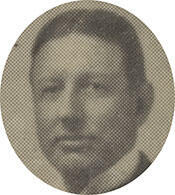
Harry Marcy Coudrey (February 28, 1867 – July 5, 1930) was a Republican member of the United States House of Representatives from Missouri who served three terms in Congress between 1905 and 1911. Born in Brunswick, Chariton County, Missouri, he was the son of J. N. and L. H. Coudrey. In 1878 he moved with his parents to St. Louis, Missouri, where he attended the city’s public schools. He completed his formal education at the Manual Training School in St. Louis, from which he was graduated in 1886, acquiring the technical and practical background that would underpin his later business career.
Following his graduation, Coudrey entered the insurance industry, a field in which he advanced rapidly. He spent three years as a special agent for the Travelers’ Insurance Company, gaining experience in casualty and surety underwriting. In 1889 he established his own insurance firm, Coudrey & Scott, in St. Louis. The firm grew in prominence and, reflecting his leadership role, was reorganized and renamed Harry M. Coudrey & Company in 1901. His professional stature in the insurance field was recognized nationally when he was elected president of the National Association of Casualty & Surety Underwriters, a position that placed him among the leading figures in that industry at the turn of the twentieth century.
Coudrey’s business interests extended beyond insurance into banking and manufacturing. He served as a director of the Washington National Bank and as director and treasurer of the Universal Adding Machine Company, participating in the financial and industrial development of St. Louis. Locally, he held a number of professional and civic leadership posts, including president of the St. Louis Fire Insurance Agents Association and secretary of the St. Louis Club. He was active in a wide range of fraternal, commercial, and social organizations, including the Masonic fraternity, the Merchants Exchange, the Business Men’s League, and the Loyal Legion. He also belonged to several prominent St. Louis clubs, among them the St. Louis University Club, Noonday Club, Mercantile Club, Athletic Club, Glen Echo Club, and Field Club, reflecting his integration into the city’s business and social elite.
Coudrey’s public career began in municipal politics. In 1897 he was elected a member of the municipal house of delegates of St. Louis, where he served for two years. During this period he became increasingly involved in Republican Party activities and local political organization. He was at one time president of the Twenty-eighth Ward Republican League Club, a role that helped establish his reputation as a party leader in St. Louis. Alongside his political activity, he remained engaged in various business enterprises in the city, reinforcing his standing as both a businessman and a civic figure.
Harry Marcy Coudrey’s service in Congress occurred during a significant period in American history, marked by the Progressive Era and major debates over economic regulation and political reform. A member of the Republican Party, he contributed to the legislative process during three terms in office and participated in the democratic process as a representative of his Missouri constituents. He entered national politics by successfully contesting, as a Republican, the election of Democrat Ernest E. Wood to the Fifty-ninth Congress. The 1904 election in his district was marred by gross fraud, and as a result of the protracted contest he was not seated until almost the end of the first session of that Congress. After prevailing in the contest, he took his seat on June 23, 1906, and thus formally began his congressional service in the Fifty-ninth Congress.
Coudrey was subsequently reelected to the Sixtieth and Sixty-first Congresses, representing Missouri in the U.S. House of Representatives from June 23, 1906, to March 4, 1911. Over these three terms, spanning the latter part of the Fifty-ninth Congress and the full terms of the Sixtieth and Sixty-first Congresses, he represented the interests of his constituents and participated in the legislative deliberations of the period. Although originally elected in the context of the 1904 contest, his continued tenure reflected his political support within his district. He chose not to be a candidate for renomination in 1910 to the Sixty-second Congress, thereby concluding his congressional career at the end of his third term in March 1911.
After leaving Congress, Coudrey relocated from Missouri to New York City in 1911. There he resumed and expanded his business pursuits, engaging in the real estate, insurance, and publishing businesses. His post-congressional career thus continued the pattern of commercial activity that had characterized his earlier life, now centered in the nation’s principal financial and publishing hub. He maintained his identity as a businessman while no longer holding elective office, and remained active in private enterprise during his later years.
Harry Marcy Coudrey died in Norfolk, Virginia, on July 5, 1930. Although he spent his final years outside Missouri, he was returned to St. Louis for burial. He was interred in Bellefontaine Cemetery in St. Louis, reflecting his long-standing ties to the city where he had been educated, built his business career, and launched his political life.
Congressional Record