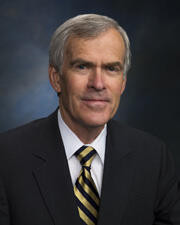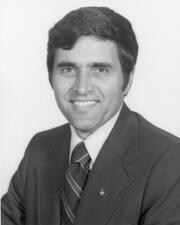
Harrison Hagan “Jack” Schmitt (born July 3, 1935) is an American geologist, former NASA astronaut, university professor, and former United States senator from New Mexico. A member of the Republican Party, he served one term in the U.S. Senate from January 3, 1977, to January 3, 1983, and is notable in American and space history as the most recent living person—and the only person without a background in military aviation—to have walked on the Moon. He remains the only professional scientist to have flown beyond low Earth orbit and to have visited the lunar surface.
Schmitt was born in Santa Rita, New Mexico, and grew up in nearby Silver City. He attended public schools and developed an early interest in geology and the natural environment of the American Southwest. He went on to study geology at the California Institute of Technology, where he earned a Bachelor of Science degree in 1957. Pursuing advanced work in the field, he received a Ph.D. in geology from Harvard University in 1964. His doctoral research and early professional work established him as a promising field geologist, and he conducted geological studies in Norway, Alaska, and other remote regions, gaining extensive experience in field mapping and mineral exploration.
Before joining NASA, Schmitt worked with the U.S. Geological Survey’s Astrogeology Branch in Flagstaff, Arizona, where he became deeply involved in the scientific planning for lunar exploration. In this role he was influential in the geology field for supporting the Apollo program and helped design and test geological procedures for astronauts on the Moon. He played a key part in training Apollo astronauts chosen to visit the lunar surface, instructing them in field geology, rock identification, and sampling techniques so that they could effectively collect scientifically valuable lunar materials.
In 1965, Schmitt was selected as part of NASA’s first group of scientist-astronauts, a cohort recruited specifically for their advanced scientific training. After extensive astronaut training, he was assigned to the Apollo program and continued to contribute to mission planning and astronaut geology training. In December 1972, he flew as the lunar module pilot on Apollo 17, the final Apollo lunar landing mission. As a crewmember of Apollo 17, Schmitt became the first member of NASA’s first scientist-astronaut group to fly in space. When he stepped onto the lunar surface, he became the twelfth and second-youngest person to set foot on the Moon. Because he returned to the Lunar Module shortly before mission commander Eugene Cernan, he is the second-to-last person to have walked on the Moon’s surface and, since Cernan’s death in 2017, the most recent person to have walked on the Moon who is still alive.
During the Apollo 17 mission, Schmitt, the only trained geologist in the astronaut corps, conducted extensive fieldwork on the lunar surface in the Taurus–Littrow valley. Among his most significant scientific contributions was the collection of the rock sample designated Troctolite 76535, which has been called “without doubt the most interesting sample returned from the Moon.” This specimen has been central to evidence suggesting that the Moon once possessed an active magnetic field. After the completion of Apollo 17, Schmitt played an active role in documenting the Apollo geologic results, analyzing samples and mission data, and publishing scientific findings. Within NASA he also took on the task of organizing the agency’s Energy Program Office, reflecting a growing institutional interest in terrestrial energy issues in the 1970s.
On August 30, 1975, Schmitt resigned from NASA to seek election as a Republican to the United States Senate representing New Mexico in the 1976 election. He campaigned for fourteen months, emphasizing themes of science, technology, and the future. In the Republican primary held on June 1, 1976, he defeated Eugene Peirce, an unknown challenger. In the general election he opposed two-term Democratic incumbent Joseph Montoya and won decisively, defeating Montoya by a margin of 57 percent to 43 percent. Schmitt’s service in Congress occurred during a significant period in American history, marked by economic challenges and evolving energy and technology policy. As a senator from New Mexico, he participated in the legislative process, represented the interests of his constituents, and contributed to national debates on science, energy, and space policy.
During his single term in the Senate, from 1977 to 1983, Schmitt was particularly active on issues related to science and technology. He served as chairman of the Science, Technology, and Space Subcommittee of the United States Senate Committee on Commerce, where he helped shape policy on space exploration, research and development, and technological innovation. His background as a geologist and astronaut informed his legislative priorities, including support for continued space exploration and the application of scientific research to national needs. In the 1982 election, he sought a second term and faced Democratic challenger Jeff Bingaman, then the attorney general of New Mexico. Bingaman criticized Schmitt for not paying sufficient attention to local matters, using the campaign slogan, “What on Earth has he done for you lately?” Amid a deep national recession and these political headwinds, Schmitt was defeated, 54 percent to 46 percent, and left office at the end of his term in January 1983.
After leaving the Senate, Schmitt remained active in public policy, academia, and space advocacy. He has served as a university professor and consultant, lecturing and writing on geology, lunar science, energy resources, and space policy. He has been involved in debates over the future direction of human spaceflight, strongly advocating a return to the Moon as a necessary step toward eventual missions to Mars. Schmitt resigned from the Planetary Society after disagreements over its “Roadmap to Space Exploration,” which recommended prioritizing earlier human missions to Mars over renewed U.S. lunar expeditions. He argued that lunar exploration was crucial for Mars missions, stating, “The fastest way to get to Mars is by way of the Moon.”
In later years, Schmitt has become a prominent critic of the scientific consensus on climate change. He has rejected the prevailing view that climate change is real, progressing, dangerous, and primarily human-caused, contending instead that climate change is predominantly driven by natural factors rather than human activity. He has argued that the risks posed by climate change are overstated and has characterized climate change as a “tool” used to advocate for the expansion of government. Schmitt resigned from the Planetary Society in part because he believed its stance on global warming—what he termed the “‘global warming scare’”—was being used as a political instrument “to increase government control over American lives, incomes and decision making,” a subject he argued should not be part of the Society’s activities. In March 2009 he spoke at the International Conference on Climate Change, an event hosted by the conservative Heartland Institute and associated with opposition to the mainstream view of anthropogenic climate change, where he described climate change as a “stalking horse for National Socialism.” Later that year, appearing on the Fox Business Network, he said that “[t]he CO2 scare is a red herring.” In a 2009 interview with radio host Alex Jones, he asserted a link between the collapse of the Soviet Union and the American environmental movement, stating that after the fall of communism, “the great champion of the opponents of liberty” had “basically went into the environmental movement.” In 2013, he co-authored an opinion column in The Wall Street Journal with physicist William Happer, arguing that increasing levels of atmospheric carbon dioxide are not significantly correlated with global warming and attributing what they called the “single-minded demonization of this natural and essential atmospheric gas” to advocates of government control of energy production. They further contended that higher carbon dioxide levels could benefit a growing global population by increasing agricultural productivity and crop resistance to drought.
Schmitt has continued to be associated with space-related initiatives and public outreach. On April 29, 2018, a device named in his honor, the Schmitt Space Communicator SC-1x, was carried aboard the Blue Origin New Shepard crew capsule in a project partly funded by NASA. Developed by the company Solstar, which Schmitt had joined as an advisor, the three-pound (1.4 kg) device was launched to an altitude of 66 miles (106 km), just past the edge of space, as a technology demonstration. The SC-1x enabled the first commercial two-way data and Wi‑Fi hotspot service in space and transmitted the first commercial Twitter message from space; the device was later admitted to the Smithsonian National Air and Space Museum. Over the years, Schmitt has appeared in documentaries and interviews, including an interview for the 1998 NOVA series “To the Moon,” and has participated in public discussions of space policy, such as commentary related to Space Policy Directive‑1. He has also engaged with international audiences, including visits such as his 2009 appearance at the University of Malta and Handaq School, and a 2022 interview on the Czech program “Hyde Park Civilization” on ČT24, reflecting his enduring role as a public figure in the history of space exploration and American public life.
Congressional Record