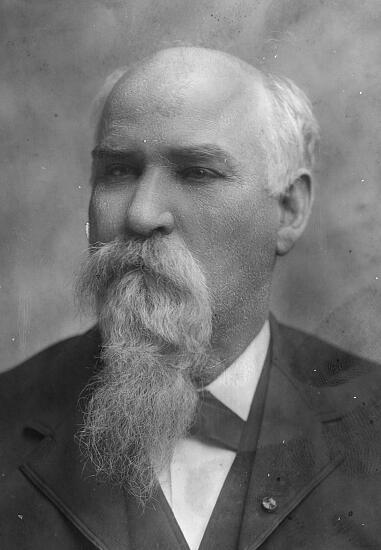
Harrison Kelley, born William Henry Harrison Kelley on May 12, 1836, in Montgomery Township, Ohio, was a Republican politician who represented Kansas in the United States House of Representatives from 1889 to 1891. He was raised in Ohio, where he attended the common schools, receiving a basic formal education typical of rural midwestern communities in the mid-nineteenth century. Seeking new opportunities on the frontier, he moved west to Coffey County, Kansas, in March 1858, settling in what would become one of the developing centers of the state. His relocation placed him in Kansas during a formative period marked by territorial conflict, statehood, and the coming of the Civil War.
With the outbreak of the Civil War, Kelley entered military service on the Union side. He enlisted in the Fifth Regiment, Kansas Volunteer Cavalry, a unit that saw active service in the Trans-Mississippi theater. Over the course of the war he advanced through all the enlisted and officer grades to the rank of captain, reflecting both experience and leadership ability. He served as captain of Company B, Fifth Kansas Cavalry, for over two years, participating in the cavalry operations that were critical to Union control in the border regions. At the close of his wartime service, he returned to Burlington, Kansas, in 1865. That same year he was commissioned a brigadier general of the Kansas State Militia, underscoring his continued role in the defense and organization of the state during the unsettled postwar period.
Following his military service, Kelley embarked on a long career in Kansas public life. He entered elective office as a member of the Kansas House of Representatives, serving from 1868 to 1870. During this time he participated in shaping state policy in the early Reconstruction era, as Kansas consolidated its institutions and addressed issues of settlement, infrastructure, and veterans’ affairs. Concurrently, he was appointed director of the Kansas State Penitentiary, a position he held from 1868 to 1873, where he was involved in the administration and oversight of the state’s correctional system at a time when Kansas was transitioning from territorial to more mature state institutions.
Kelley continued to hold important administrative and federal patronage posts in the late 1870s. He served as receiver of the United States land office at Topeka in 1877 and 1878, a key position in managing federal lands and overseeing claims and sales as Kansas continued to attract settlers and develop its agricultural base. He later served as a deputy collector of internal revenue, participating in the federal government’s tax administration in the region. In addition to these roles, he was active in regulatory and charitable oversight within the state, serving as chairman of the Kansas livestock sanitary commission, where he helped supervise animal health and livestock regulations critical to the state’s ranching and farming economy, and as treasurer of the Kansas State Board of Charities in 1889, contributing to the financial management of state charitable and benevolent institutions.
Kelley’s legislative career advanced to the upper chamber of the state legislature when he served in the Kansas State Senate from 1880 to 1884. In that capacity he took part in debates and legislation affecting railroads, agriculture, public institutions, and the broader economic development of Kansas during a period of rapid growth and periodic economic strain. His combined experience in the militia, state legislature, and administrative posts helped establish his reputation as a capable Republican leader and prepared him for national office.
Harrison Kelley entered the national stage when he was elected as a Republican to the Fifty-first Congress to fill the vacancy caused by the resignation of Representative Thomas Ryan. He represented Kansas in the U.S. House of Representatives from December 2, 1889, to March 3, 1891, serving one full term. During this significant period in American history, marked by industrial expansion, agrarian unrest, and debates over tariffs and monetary policy, Kelley participated in the legislative process and represented the interests of his Kansas constituents. As a member of the House of Representatives, he contributed to the work of the Republican majority in the Fifty-first Congress, sometimes known as the “Billion-Dollar Congress,” which enacted substantial legislation on economic and veterans’ issues. Although he served only a single term, his congressional service capped more than two decades of public engagement at the state and federal levels.
After leaving Congress in 1891, Kelley returned to Kansas and resumed private life in Burlington, while remaining a respected figure in state political and civic circles. He lived there until his death on July 24, 1897, in Burlington, Kansas. Harrison Kelley was interred in Bowman Cemetery at Ottumwa, near Burlington, Kansas, closing a life that had spanned the antebellum era, the Civil War, Reconstruction, and the emergence of Kansas as a firmly established state in the American Union.
Congressional Record