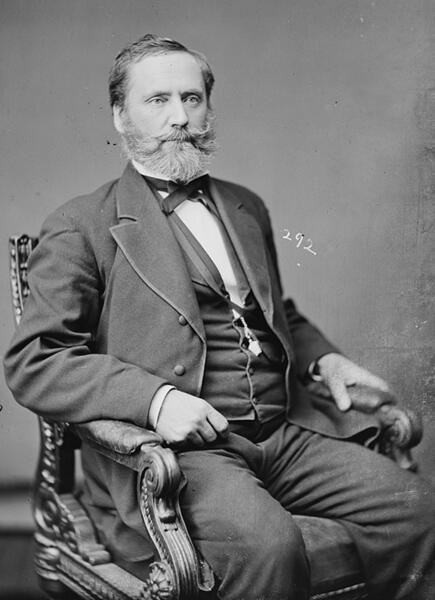
Harris Merrill Plaisted (November 2, 1828 – January 31, 1898) was an attorney, politician, and Union Army officer from Maine who served as a U.S. Representative and later as the 38th governor of Maine. Over the course of his public career he was successively a Republican and then a Greenback Party leader, and he held a series of important state and federal offices, including service in the Maine House of Representatives and as Maine Attorney General. In the United States Congress, he represented Maine from 1875 to 1877, completing one term in the House of Representatives.
Plaisted was born and raised in Jefferson, Coös County, New Hampshire, on November 2, 1828. He was educated in local schools before pursuing higher education in Maine, enrolling at Waterville College (now Colby College), from which he graduated in 1853. He subsequently studied law at Albany Law School in Albany, New York, receiving his legal education there in 1855. After admission to the bar, he settled in Bangor, Maine, where he established a law practice and became identified with the legal and civic life of the community.
With the outbreak of the American Civil War, Plaisted entered military service in defense of the Union. In 1861 he was commissioned a lieutenant colonel in the Union Army and named second in command of the 11th Maine Volunteer Infantry Regiment. The following year, in 1862, he was promoted to colonel and assumed command of the regiment. Under his leadership, the 11th Maine took part in numerous engagements in South Carolina and Virginia, including operations around Charleston and the protracted Siege of Petersburg. For his gallant and meritorious services during the war, Plaisted was appointed a brevet brigadier general of volunteers in February 1865, and in 1867 he received the additional honorary rank of brevet major general of volunteers, placing him among the many officers recognized after the conflict as brevet generals of the Union Army.
After the war, Plaisted returned to Bangor and resumed the practice of law while entering public life as a Republican. He was elected to the Maine House of Representatives, serving from 1867 to 1868, where he participated in state legislative affairs during the early Reconstruction era. In 1868 he was chosen as a delegate to the Republican National Convention, reflecting his growing prominence within the party. In 1873 the Maine Legislature selected him to serve as Maine Attorney General, a position to which he was reappointed in 1874 and 1875. As attorney general he was the chief legal officer of the state, representing Maine’s interests in court and advising state officials on legal matters until his resignation in late 1875.
Plaisted’s service in the United States Congress occurred during a significant period in American history, as the nation continued to grapple with the aftermath of the Civil War and Reconstruction. In September 1875 he was elected as a Republican to the U.S. House of Representatives in a special election to fill a vacancy, and in December 1875 he resigned as Maine Attorney General in order to take his seat. Serving from December 6, 1875, to March 3, 1877, he represented Maine for one term in the Forty-fourth Congress. As a member of the House of Representatives, Harris Merrill Plaisted participated in the legislative process, contributed to debates on national policy, and represented the interests of his Maine constituents. He did not seek election to a full term at the conclusion of this service.
In the years following his congressional term, Plaisted’s political views shifted in response to the economic and monetary issues of the postwar era. In 1878 he left the Republican Party, dissatisfied with its monetary policy, particularly its commitment to hard money and the contraction of the currency. He joined the Greenback Party, which advocated an expanded paper currency to assist farmers, laborers, and debtors. In 1880 he was nominated as the fusion candidate of the Greenback and Democratic parties for governor of Maine. He won the election and served as the state’s 38th governor from 1881 to 1883, during which time he confronted contentious fiscal and political questions, including debates over taxation, public spending, and electoral reform in a period of closely divided party strength in Maine.
After leaving the governorship in 1883, Plaisted returned once more to his legal practice in Bangor and remained an influential figure in Maine politics and public affairs, though he did not again hold major elective office. He continued to be identified with the reform and monetary issues that had drawn him to the Greenback movement, while maintaining his standing as a respected lawyer and former soldier. Harris Merrill Plaisted died in Bangor, Maine, on January 31, 1898. He was buried at Mount Hope Cemetery in Bangor, closing a career that had spanned military command in the Civil War, service in the state legislature and as attorney general, a term in the U.S. House of Representatives, and the governorship of Maine.
Congressional Record