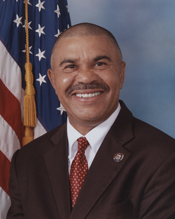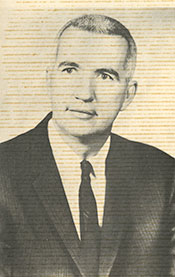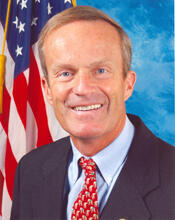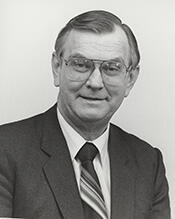
Harold Lee Volkmer (April 4, 1931 – April 16, 2011) was an American politician and attorney from Missouri who served as a Democratic Representative in the United States House of Representatives from 1977 to 1997. Over the course of 10 consecutive terms, spanning 20 years in Congress, he represented a largely rural, 21-county district in northeastern Missouri and became known as an energetic, blunt-talking lawmaker with a maverick streak and a complex ideological profile.
Volkmer grew up in Jefferson City, Missouri, where he developed an early interest in politics by helping his mother campaign in Jefferson City for the re-election of President Franklin D. Roosevelt. He attended Jefferson City Junior College and then Saint Louis University before pursuing legal studies at the University of Missouri. Demonstrating notable legal aptitude, he passed the Missouri bar examination even before graduating from law school. In 1955 he married Shirley Ruth Braskett, with whom he had two sons and a daughter; she preceded him in death in 1995. Also in 1955, he entered the United States Army, serving on active duty until 1957.
After completing his military service and legal education, Volkmer quickly entered public service. He first served as an Assistant Attorney General for the State of Missouri, gaining experience in state legal affairs. He then established and operated a private law practice in Hannibal, Missouri, which became his home for the rest of his life. In 1960 he was elected Prosecuting Attorney for Marion County, marking his first elective office and giving him a prominent role in local law enforcement and county legal matters.
Volkmer’s state legislative career began with his election to the Missouri House of Representatives in 1966. He was re-elected four times, serving a total of ten years in the Missouri legislature. During this period, he earned a reputation, in the words of the St. Louis Post-Dispatch, as an “energetic blunt-talking lawyer” and “a maverick.” He played a leading role in a major reorganization of the executive branch of Missouri state government, a complex restructuring effort for which even the Republican minority leader later credited him as “the brains for all of us,” acknowledging that legislators from both parties looked to him for leadership on the issue. As Chairman of the Missouri House Judiciary Committee, Volkmer sought and obtained approval of the Equal Rights Amendment by the Missouri House of Representatives, aligning himself with efforts to advance gender equality under the law at the state level.
In 1976, Volkmer was elected to the United States House of Representatives as a Democrat from Missouri, beginning his congressional service on January 3, 1977. He was re-elected nine times, serving a total of 10 terms until January 3, 1997. His tenure in Congress coincided with a significant period in American political and economic history, including debates over agricultural policy, civil rights, environmental regulation, and the size and scope of the federal government. Representing a mostly rural district in northeastern Missouri, he became closely identified with agricultural issues and the concerns of farmers and small communities.
In the House of Representatives, Volkmer served on the House Agriculture Committee, where he helped shape five major farm bills, reinforcing his standing as an advocate for rural America and agricultural interests. He also served for several of his early terms on the House Judiciary Committee, continuing the legal and constitutional focus that had marked his state legislative career. He supported the Panama Canal Treaty Enabling Legislation in 1978 and backed the modernization of United States bankruptcy laws that same year. He also supported the creation of the U.S. Department of Education, reflecting his interest in federal education policy. On civil rights and social policy, he voted for the extension of the Voting Rights Act in 1982 and supported the extension and expansion of the Fair Housing Act in 1988. He backed the strengthening and expansion of major environmental statutes, including Superfund, the Clean Water Act, and the Clean Air Act, and he opposed certain Pentagon weapons programs that he regarded as wasteful and unnecessary.
Volkmer developed a reputation as a conservative Democrat, particularly because of his opposition to gun control legislation, abortion, and gay rights. These positions, highly salient in national political debates, often overshadowed his more progressive stances on civil rights, environmental protection, and education. His most prominent legislative achievement in the area of firearms policy was his role as one of the primary sponsors of the 1986 McClure-Volkmer Act, formally known as the Firearm Owners Protection Act. This law amended the Gun Control Act of 1968 by establishing an expanded system of rules and procedures governing compliance inspections of federally licensed firearms dealers. Legal scholar Dave Kopel later wrote that, “line by line, FOPA significantly strengthened statutory protections of the Second, Fourth, Fifth, Ninth, and Tenth Amendments,” and characterized it as one of the most far-reaching laws enacted by Congress to safeguard constitutional rights.
For much of his congressional career, Volkmer was comfortably re-elected. Between 1978 and 1990 he faced only one close race, in 1984, and generally “skated” to victory in his district. The political climate shifted in the early 1990s, however, and his elections became increasingly competitive. In 1992 he narrowly defeated Republican challenger Rick Hardy, a political science professor at the University of Missouri, by a margin of only about 5,800 votes. In 1994 he again faced a tight contest, this time against Republican assistant attorney general Kenny Hulshof, and was returned to office with just 50.4 percent of the vote. In 1996, Hulshof challenged him again and defeated him by just under 5,900 votes. Following Volkmer’s departure, Democrats struggled to regain footing in the district, now numbered as Missouri’s 3rd Congressional District, and have only once surpassed the 40 percent vote threshold there since his loss.
After leaving Congress in 1997, Volkmer remained active in public affairs and policy. He served as chairman of the National Commission on Small Farms, continuing his long-standing advocacy for agricultural and rural issues at the national level. Reflecting his prominence in firearms policy and his strong support for gun owners’ rights, members of the National Rifle Association overwhelmingly elected him to their Board of Directors, on which he served for the next 12 years. He continued to reside in Hannibal, Missouri, maintaining his ties to the community where he had practiced law and launched his political career.
Harold Lee Volkmer died in Hannibal on April 16, 2011, at the age of 80, from pneumonia. At the time of his death, he was remembered as a long-serving congressman who had represented Missouri in the United States House of Representatives for 20 years, a legislator who combined conservative and progressive positions in ways that reflected both his rural constituency and his own independent judgment, and a public servant whose career spanned local, state, and national office.
Congressional Record