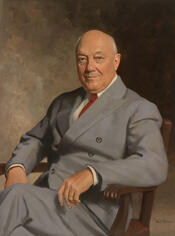
Harold Knutson (October 20, 1880 – August 21, 1953) was an American politician and journalist who represented Minnesota in the United States House of Representatives from 1917 to 1949 as a member of the Republican Party. He was born in Skien, in Telemark county, in the United Kingdoms of Sweden and Norway, and was raised in a Lutheran family. At the age of six he immigrated with his family to the United States. They initially settled in Chicago, Illinois, before moving to Sherburne County, Minnesota, where he grew up in the Upper Midwest community that would later form the base of his political career.
Knutson entered the newspaper profession as a young man and established himself as a prominent journalist in central Minnesota. He became editor of the St. Cloud Daily Journal-Press, a position that gave him a public platform and close contact with local political and economic issues. His influence in regional journalism expanded as he later served as president of the Northern Minnesota Editorial Association. Through his editorial work he developed a reputation as a spokesman for his community and a committed Republican, which helped propel him into elective office.
In 1916 Knutson was elected to the United States House of Representatives as a Republican from Minnesota, beginning a congressional career that would span 16 consecutive terms. He served from March 4, 1917, to January 3, 1949, sitting in the 65th through the 80th Congresses. His tenure in Congress coincided with a period of profound change in American history, including World War I, the interwar years, the Great Depression, World War II, and the early Cold War. As a member of the House of Representatives, he participated in the legislative process and represented the interests of his Minnesota constituents over more than three decades.
Knutson quickly rose within the House Republican leadership. From 1919 to 1923 he served as the Republican majority whip, helping to marshal party votes and shape legislative strategy during the post–World War I era. On April 5, 1917, he was among those who voted against declaring war on Germany, reflecting a non-interventionist outlook that would mark much of his public life. Throughout the 1920s and 1930s he was known as a leading isolationist in Congress, frequently opposing measures that he believed might draw the United States into foreign conflicts.
During World War II and the years immediately preceding American entry into the conflict, Knutson’s isolationism became increasingly controversial. He was widely regarded as overtly sympathetic to Nazi Germany, and his public statements were criticized by interventionists and administration supporters. Even after the attack on Pearl Harbor in December 1941, he delivered an address that was condemned by many as “defeatist.” Nazi German documents later described him as “an asset” for the Nazi cause, a characterization that further damaged his standing among critics and contributed to the contentious reputation he held during the war years.
Despite the controversy surrounding his foreign policy views, Knutson continued to hold important committee assignments and leadership roles. In the 80th Congress, from 1947 to 1949, he served as chairman of the powerful House Ways and Means Committee, placing him at the center of debates over taxation, revenue, and postwar economic policy. His long service made him one of the senior Republican figures in the House, and he remained an influential voice on fiscal and domestic issues even as his stance on foreign affairs drew opposition.
Knutson was defeated for re-election in 1948, ending his three-decade-long tenure in Congress. After leaving office in January 1949, he returned to the newspaper field and resumed editorial work in Minnesota, continuing in that profession until his death. He died in Wadena, Minnesota, on August 21, 1953. His papers are preserved and available for research at the Minnesota Historical Society, documenting both his journalistic and legislative careers.
In his later years and posthumously, Knutson’s name became associated with several institutions and landmarks in Minnesota. He was a member of the Freemasons, the Benevolent and Protective Order of Elks, and the Independent Order of Odd Fellows, reflecting his engagement in fraternal and civic organizations. In 1953 he donated property at Cross Lake, Minnesota, to be used as a summer retreat for “neglected, unfortunate, deprived and handicapped children.” This gift became Camp Knutson, an accepting and nurturing camp environment for children with special needs that has, for more than half a century, hosted thousands of young participants and continued to be supported and improved by those inspired by his vision. In addition, Knutson Dam on the Mississippi River at Cass Lake was named in his honor, further commemorating his long public service and regional influence.
Congressional Record