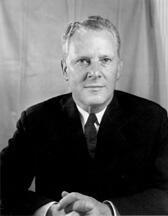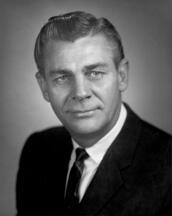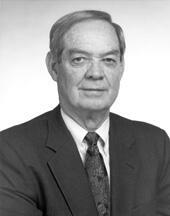
Harlan Mathews (January 17, 1927 – May 9, 2014) was an American politician who served as an appointed interim Democratic United States Senator from Tennessee from 1993 to 1994. A member of the Democratic Party, he contributed to the legislative process during one term in office, representing the interests of his Tennessee constituents during a significant period in American history. Before his service in Congress, Mathews spent more than four decades in Tennessee state government, holding key positions in both the executive and legislative branches beginning in 1950.
Mathews was born on January 17, 1927, in Sumiton, Alabama, to John William Mathews and Lillian (Young) Mathews. He completed high school in 1944 and, during the final years of World War II, enlisted in the United States Navy, serving from 1944 until 1946. After his military service, he returned to Alabama and pursued higher education, earning a Bachelor of Arts degree from Jacksonville State College (now Jacksonville State University) in 1949. He then moved to Tennessee to continue his studies, obtaining a Master of Public Administration degree from Vanderbilt University in 1950, an academic foundation that would shape his long career in public finance and administration.
Mathews began his public service career in 1950 on the planning staff of Tennessee Governor Gordon Browning, marking the start of his extensive involvement in state government. After the election of Governor Frank G. Clement in 1954, he joined the state’s budget staff, where he developed expertise in fiscal policy and state budgeting. Over the next decade, he served successive Democratic administrations, including those of Governors Frank G. Clement and Buford Ellington, and became a trusted figure in state financial management. In 1961, he was appointed commissioner of finance and administration, a cabinet-level post in which he oversaw Tennessee’s budget and administrative operations. While serving in that role, he furthered his education by completing a law degree in 1962 from the YMCA Night Law School, now known as the Nashville School of Law.
From 1961 to 1971, Mathews served as Tennessee’s commissioner of finance and administration, playing a central role in shaping the state’s fiscal policies during a period of growth and modernization. In January 1971, he left the state cabinet and entered the private sector, working for approximately two years with Amcon International in Memphis. He returned to public service in 1973 as legislative assistant to longtime Tennessee Comptroller of the Treasury Bill Snodgrass, deepening his involvement with the General Assembly and state financial oversight. In 1974, following the resignation of State Treasurer Tom Wiseman, who left office to run for governor, the Tennessee General Assembly elected Mathews as state treasurer. He was elected to his first full two-year term as treasurer in 1975 and was repeatedly re-elected, ultimately serving as Tennessee state treasurer from 1974 until January 1987. In that capacity, he was responsible for managing state funds, investments, and pension systems, and became one of the longest-serving treasurers in Tennessee history.
In January 1987, Mathews left the treasurer’s office to become deputy to Governor Ned R. McWherter, serving as a senior adviser and administrator in the governor’s office. His long record of experience in state finance and administration made him a key figure in the McWherter administration and positioned him for later federal service. When U.S. Senator Al Gore of Tennessee resigned his Senate seat in early 1993 to assume the office of Vice President of the United States, Governor McWherter turned to Mathews to fill the resulting vacancy. On January 2, 1993, McWherter appointed Mathews to the United States Senate, explicitly describing his role as that of a caretaker to allow prospective candidates time to prepare for the upcoming special election.
During his tenure in the United States Senate from 1993 to 1994, Harlan Mathews participated fully in the democratic process and contributed to the legislative work of the chamber, representing Tennessee during the early years of the Clinton administration. In mid-1993, Mathews publicly expressed interest in running in the November 1994 special election to complete the remainder of Gore’s Senate term, noting that “hardly a day goes by that I don’t get encouraged to get in there and offer myself” for the election. Ultimately, he decided not to become a candidate, honoring the caretaker understanding under which he had been appointed. After Republican Fred Thompson won the special election in November 1994, Mathews concluded his Senate service in December 1994 and left office in early 1995, having served one term in Congress as an appointed interim senator.
Following his departure from the Senate, Mathews returned to private life in Nashville, Tennessee, where he resumed the practice of law. Drawing on his decades of experience in state and federal government, he remained an influential figure in Tennessee political and civic circles, and his papers from his Senate service were later deposited with the Tennessee State Library and Archives, documenting his brief but notable tenure in the U.S. Senate and his long career in public service.
Harlan Mathews died of brain cancer on May 9, 2014, at a hospice in Nashville, Tennessee. He was survived by his wife, Pat, and two sons; a third son, Richard Mathews, had preceded him in death. His career, spanning from his early work on the staff of Governor Gordon Browning in 1950 through his service as state treasurer, deputy governor, and United States senator, reflected more than forty years of continuous engagement in Tennessee’s public life.
Congressional Record