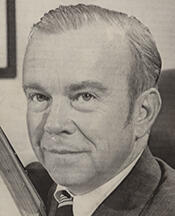
Hardie Scott (June 7, 1907 – November 2, 1999) was an American lawyer and politician who served as a Republican member of the United States House of Representatives for Pennsylvania’s 3rd congressional district from 1947 to 1953. His three consecutive terms in Congress placed him at the center of the national legislative process during the early Cold War era, when he represented the interests of his Philadelphia-area constituents in the United States House of Representatives.
Scott was born in Bala Cynwyd, Pennsylvania, on June 7, 1907, the son of attorney and future congressman John Roger Kirkpatrick Scott. Raised in a family with a strong legal and civic background, he attended the Taft School in Watertown, Connecticut, graduating in 1926. He then enrolled at Yale University, where he graduated in 1930. During his time at Yale, Scott distinguished himself in athletics as captain of the 1930 Yale polo team, leading the team to the intercollegiate polo championship. He was also a member of the Psi Upsilon fraternity, reflecting an early engagement with campus leadership and social organizations.
Following his undergraduate studies, Scott pursued legal training at the University of Pennsylvania Law School, from which he graduated in 1934. He was admitted to the Pennsylvania state bar in 1935 and entered into the practice of law with his father, further embedding himself in the legal and civic life of the Philadelphia region. Early in his career he served as assistant city solicitor and also held the position of special duty attorney general, roles that provided him with experience in public law and governmental affairs at the local and state levels.
During World War II, Scott served in the United States Army. His military service was cut short when he was discharged on account of deafness, but his time in uniform coincided with the formative years of his public service. Returning to civilian life and the practice of law, he soon transitioned into electoral politics, drawing on both his legal background and his family’s political legacy.
Scott was elected as a Republican to the Eightieth, Eighty-first, and Eighty-second Congresses, serving from January 3, 1947, to January 3, 1953. As a Representative from Pennsylvania, he participated fully in the legislative process during a significant period in American history marked by postwar reconstruction, the onset of the Cold War, and domestic economic adjustment. Among his notable contributions in Congress was his introduction of the bill that authorized the creation of what eventually became Independence National Historical Park in Philadelphia, a major federal initiative to preserve and interpret key sites associated with the American Revolution and the founding of the United States. After three terms, he was not a candidate for renomination in 1952, concluding his congressional service at the start of 1953.
Following his departure from Congress, Scott returned to legal and regulatory work in Pennsylvania. He served as counsel for the State Securities Commission, applying his legal expertise to the oversight of securities and financial regulation. He later became an associate counsel with the Philadelphia law firm Dechert, Price & Rhoads, one of the region’s leading firms, where he continued his legal career until his retirement. His post-congressional work reflected a continued engagement with public policy and corporate regulation, even outside elective office.
In his personal life, Scott married Almira Geraldine Rockefeller, known as Mrs. MacRoy Jackson, in 1952. The couple shared an interest in equestrian pursuits and bred and trained racehorses, an activity that complemented Scott’s long-standing association with sporting and social clubs. He was a member of the Racquet Club, Radnor Hunt, and the Union League of Philadelphia, organizations that reflected his social standing and his continued involvement in civic and recreational life in the Philadelphia area.
Hardie Scott died at his home in Edgmont, Pennsylvania, on November 2, 1999, at the age of 92. He was interred at West Laurel Hill Cemetery in Bala Cynwyd, Pennsylvania, returning in death to the community where he had been born. His career encompassed service as a lawyer, soldier, and legislator, and his role in establishing the legislative foundation for Independence National Historical Park left a lasting imprint on the nation’s historical landscape.
Congressional Record