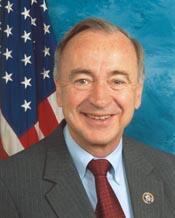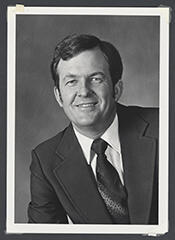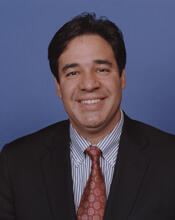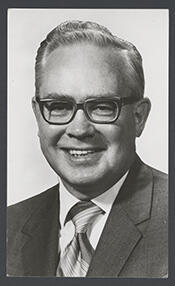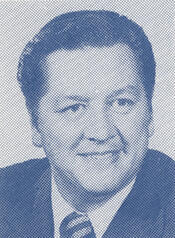
Hamer Harold Budge (November 21, 1910 – July 22, 2003) was an American attorney and politician who served as a Representative from Idaho in the United States Congress from 1951 to 1961 and later chaired the Securities and Exchange Commission. A member of the Republican Party, he was a five-term congressman from Idaho and became the first member of the Church of Jesus Christ of Latter-day Saints (Mormon) to represent Idaho in either house of Congress. His decade in the House of Representatives coincided with a significant period in American history, during which he contributed to the legislative process over five terms in office and represented the interests of his constituents in Idaho’s 2nd congressional district.
Budge was born in Pocatello, Idaho, on November 21, 1910, the youngest of eight children of Alfred Budge and Ella Hoge Budge. His father, Alfred Budge, was a prominent jurist who was appointed to the Idaho Supreme Court in November 1914, prompting the family’s relocation from Pocatello to Boise. Alfred Budge served on the state’s highest court for 34 years, retiring in December 1948 at the age of 80. Hamer Budge was also the grandson of William Budge, a notable Idaho political figure, and grew up in a family deeply involved in public affairs and the law, an environment that strongly influenced his later career in public service.
Budge attended public schools in Boise and then enrolled at the College of Idaho in Caldwell. He later transferred to Stanford University in Palo Alto, California, where he completed his undergraduate studies and graduated in 1933. Following his time at Stanford, he pursued legal training at the University of Idaho College of Law in Moscow. After earning his law degree in 1936, he was admitted to the bar and entered private legal practice in Boise, beginning a professional career that combined law and politics for the rest of his life.
His early political career began in the Idaho state legislature, where he served as a member of the Idaho House of Representatives from 1939 through 1941. With the onset of World War II, Budge entered military service; he served in the United States Navy from 1942 through 1945 and rose to the rank of lieutenant commander. After the war, he returned to Idaho and again took part in state politics, serving another term in the Idaho legislature in 1949. These experiences in state government and military service helped establish his credentials as he moved onto the national stage.
When Republican Congressman John Sanborn chose to run for the U.S. Senate rather than seek a third term in the House in 1950, the seat for Idaho’s 2nd congressional district became open. Both major-party nominees for the seat were from Boise, and Budge secured the Republican nomination. In the 1950 general election he defeated Democratic state senator James Hawley, thereby entering the U.S. House of Representatives. He took office in January 1951 and served five consecutive terms, remaining in the House until January 1961. During his tenure in Congress, Budge participated in the democratic process at the federal level and was involved in legislative debates during the early Cold War, the Eisenhower administration, and the initial years of the civil rights era. He voted against the Civil Rights Act of 1957 and the Civil Rights Act of 1960, positions that placed him among those members who opposed early federal civil rights legislation. In 1960 he sought a sixth term but was defeated by 31-year-old Democrat Ralph Harding of Blackfoot, bringing his congressional service to a close after ten years.
Following the end of his fifth congressional term in 1961, Budge returned to Idaho and resumed his legal career in a judicial capacity. He became a judge in the Third Judicial District of Idaho, based in Boise, where he served on the state bench and continued his involvement in public service at the state level. His judicial work further solidified his reputation as a lawyer and public official with broad experience in both legislative and judicial branches of government.
Budge’s career entered a new phase in 1964 when President Lyndon B. Johnson appointed him to the United States Securities and Exchange Commission (SEC). As an SEC commissioner, he participated in the regulation and oversight of the nation’s securities markets during a period of expanding public participation in investing. Under President Richard M. Nixon, Budge was elevated to chairman of the SEC, a position he held from 1969 until his resignation on January 2, 1971. As chairman, he oversaw the agency’s efforts to maintain fair and orderly markets and enforce federal securities laws during a time of significant economic and financial change.
After leaving the SEC, Budge moved into the private financial sector. He became president of a mutual funds group in Minneapolis, where he applied his legal and regulatory experience to the management and oversight of investment funds. He served in this capacity until his retirement in 1978. Throughout his professional life, he was active in civic and professional organizations, including membership in the Elks, the Fraternal Order of Eagles, the American Bar Association, and the Sigma Alpha Epsilon fraternity, reflecting his continued engagement with both legal and community affairs.
Hamer Harold Budge spent his later years in retirement and remained a figure of historical interest in Idaho and national financial regulation circles. He died on July 22, 2003, in Arizona at the age of 92. His long career spanned state and federal legislative service, wartime military duty, a state judgeship, and leadership of the Securities and Exchange Commission, marking him as a significant twentieth-century public servant from Idaho.
Congressional Record