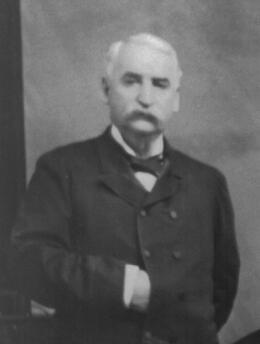
Guy Ray Pelton (August 3, 1824 – July 24, 1890) was an American lawyer and politician from New York who served as a U.S. Representative in the Thirty-fourth United States Congress from 1855 to 1857. A member of the Independent Party during his term in Congress and associated with the Whig Party in his broader political career, he contributed to the legislative process during one term in office and represented the interests of his New York constituents during a turbulent period in American history.
Pelton was born in Great Barrington, Berkshire County, Massachusetts, on August 3, 1824, the second son of Joseph Kneeland Pelton and Harriet Ray. He was educated in the local public schools and continued his studies at the Sedgwick Institution in Great Barrington. He later attended the Connecticut Literary Institute in Suffield, Connecticut, where he received further classical and preparatory education. Seeking advanced study, he enrolled at Oberlin College in Ohio, an institution known for its early commitment to coeducation and abolitionism, which exposed him to the reform currents of the antebellum period.
After his collegiate studies, Pelton turned to the law. He studied in Kinderhook, New York, a community with a strong legal and political tradition, and was admitted to the bar in 1851. Following his admission, he commenced the practice of law in New York City, where he formed a partnership with his older brother, Timothy Dwight Pelton. In addition to his legal work, he became involved in business ventures, including participation in a rubber manufacturing company, reflecting the growing industrial and commercial opportunities of mid-nineteenth-century New York. Pelton was also active in civic and social organizations; he was a member of the Union League Club, an influential association of professionals and civic leaders, and a Freemason, which further connected him to the city’s professional and political networks.
Pelton’s political career developed in the context of the declining Whig Party and the realignment of national politics in the 1850s. Identified as a Whig, and also described as an Independent in connection with his congressional service, he was elected in 1854 as a Representative from New York to the Thirty-fourth Congress, serving from March 4, 1855, to March 3, 1857. His term coincided with a significant period in American history marked by sectional conflict over slavery and the aftermath of the Kansas-Nebraska Act. In the House of Representatives, Pelton served on the Committee on Commerce, where he participated in deliberations affecting trade, navigation, and the commercial interests of his largely urban constituency. As a member of the House, he took part in the democratic process and contributed to the legislative work of the chamber during a time of intense national debate.
At the conclusion of his term, Pelton sought to continue his service in Congress but was an unsuccessful candidate for reelection in 1856. After leaving office on March 3, 1857, he returned to his legal and business pursuits in New York City. His post-congressional years were marked by continued engagement in professional life, civic organizations such as the Union League Club, and fraternal activities through the Freemasons, maintaining his standing in New York’s legal and commercial circles.
Pelton’s personal life included two marriages. In 1859, he married Mary Childs Franklin. The couple had one son, Franklin Dwight Pelton. Mary Childs Franklin Pelton died in 1866. Several years later, in 1879, Pelton married Angelina Scoville. These family relationships, together with his professional and political activities, anchored him in both New York and his native Massachusetts throughout his adult life.
In his later years, Pelton traveled extensively. In 1890 he undertook a journey to Alaska and, on his return eastward to his home in Massachusetts, visited Yellowstone National Park. On July 24, 1890, while climbing Mary Mountain in Yellowstone National Park, Wyoming, he died unexpectedly. His body was returned to his birthplace, and he was buried at Mahaiwe Cemetery in Great Barrington, Massachusetts, closing the life of a nineteenth-century lawyer, businessman, and one-term congressman who had participated in the national legislature during a formative era in United States history.
Congressional Record