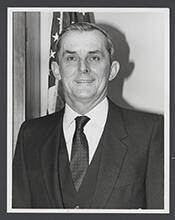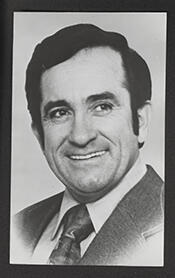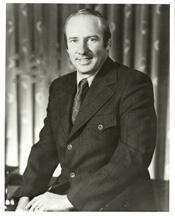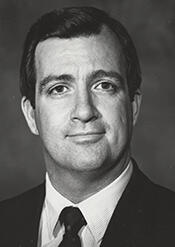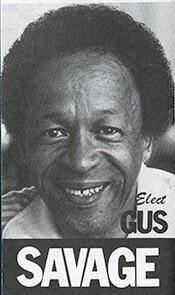
Augustus Alexander “Gus” Savage (October 30, 1925 – October 31, 2015) was an American entrepreneur, publisher, and Democratic member of the United States House of Representatives from Illinois. He served as a Representative from Illinois in the United States Congress from 1981 to 1993, completing six terms in office. Over the course of his public life, he became known both for his advocacy on behalf of his constituents and for his long involvement in African American journalism and political activism.
Savage was born on October 30, 1925, in Detroit, Michigan, and moved with his family to Chicago, Illinois, as a child. Growing up on Chicago’s South Side, he was exposed early to the economic and social challenges facing African American communities in an era of segregation and limited opportunity. His formative years in Chicago helped shape his later commitment to civil rights, urban issues, and Black political empowerment, themes that would recur throughout his professional and political career.
During World War II, Savage served in the United States Army from 1943 to 1946. His military service, which coincided with a period of profound change in American society, provided him with firsthand experience of both the possibilities and contradictions of American democracy. After his discharge, he returned to Chicago and pursued higher education, enrolling at Roosevelt University. He studied there in the postwar years, a time when many veterans were using the G.I. Bill to gain access to college and professional training, and he developed interests that would lead him into journalism, publishing, and political organizing.
Savage’s early career was rooted in entrepreneurship and the Black press. He became a journalist and later a publisher, using his platforms to address issues affecting African Americans in Chicago and beyond. Through his work in publishing, he highlighted civil rights struggles, housing discrimination, police misconduct, and economic inequality. His role as an entrepreneur in the media sphere made him a prominent voice in local and regional debates and helped build the public profile that would eventually support his entry into electoral politics. His experience as a publisher also gave him a detailed understanding of community concerns, which he later carried into his legislative work.
In 1980, Savage was elected as a Democrat to the United States House of Representatives from Illinois, taking office on January 3, 1981. A member of the Democratic Party, he contributed to the legislative process during six terms in office, serving until January 3, 1993. His service in Congress occurred during a significant period in American history, spanning the Reagan and George H. W. Bush administrations, when debates over civil rights, social welfare, urban policy, and U.S. foreign affairs were particularly intense. As a member of the House of Representatives, Savage participated in the democratic process and represented the interests of his constituents from Chicago’s South Side and surrounding areas, focusing on issues such as economic development, housing, and opportunities for minority communities.
Throughout his twelve years in Congress, Savage was known as an outspoken and often controversial figure, reflecting both the frustrations and aspirations of many of his constituents. He aligned with the broader Democratic coalition on social and economic issues, while also emphasizing the need for greater representation and resources for African American neighborhoods. His tenure coincided with major national discussions about the role of government in addressing poverty, crime, and education, and he used his position to press for policies he believed would benefit urban districts like his own. His years in office also drew significant media attention, and his activities and statements were frequently covered in national outlets, including The New York Times and C-SPAN, underscoring his prominence on the national political stage.
After leaving Congress in 1993, Savage remained associated in the public mind with his earlier work as an entrepreneur and publisher and with his long record of political engagement. Although no longer in elective office, he continued to be cited in discussions of Chicago politics, African American representation, and the history of Black political leadership in the late twentieth century. He lived out his later years in Illinois, maintaining ties to the community that had shaped his life and career.
Gus Savage died on October 31, 2015, one day after his 90th birthday. His passing marked the end of a career that spanned military service in World War II, entrepreneurship in the Black press, and six terms in the United States House of Representatives. His life reflected the trajectory of a generation of African American leaders who emerged from segregated neighborhoods and wartime service to play significant roles in journalism, activism, and national politics.
Congressional Record