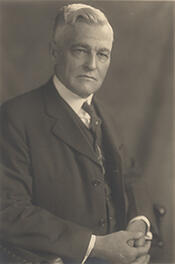
Guinn Terrell Williams (April 22, 1871 – January 9, 1948) was an American banker and Democratic politician who served as a Representative from Texas in the United States Congress from 1921 to 1933. Most notable for his six terms as a U.S. representative, he also served in the Texas State Senate and held several local offices in Texas. Over the course of his public career, Williams contributed to the legislative process during a significant period in American history, representing the interests of his Texas constituents in both state and national government. His son was the film actor Guinn “Big Boy” Williams.
Williams was born near Beulah, Bolivar County, Mississippi, the son of farmer and Confederate veteran William Washington Williams and Minerva Jane (Thompson) Williams. In 1876, when he was a child, he moved with his parents to Nocona, Texas, and shortly thereafter the family settled in Decatur in Wise County. He attended the public schools of Wise County and qualified as a schoolteacher. Williams taught school for several terms, demonstrating an early commitment to education, before pursuing further studies at Transylvania College in Lexington, Kentucky.
After graduating from Transylvania College in 1890, Williams returned to Texas and became active in ranching and farming, while simultaneously embarking on a career in banking. He first gained banking experience as cashier of the State National Bank in Fort Worth. He later helped incorporate the City National Bank in Decatur and served as its vice president, becoming a prominent figure in regional finance. Williams went on to establish and preside over several banks in Texas communities including Mineral Wells, Perrin, Bridgeport, and Paradise, reflecting his growing influence in both agricultural and financial circles.
Williams’s political career began at the local level. A committed Democrat, he served as Wise County Clerk from 1898 to 1902, an office that gave him experience in county administration and public records. Building on this foundation, he advanced to state office when he was elected to the Texas State Senate in 1919. He served in the Senate from 1920 to 1922, participating in state legislative affairs during a period of economic and social change in Texas. His work in the state legislature helped establish his reputation as a capable lawmaker and set the stage for his subsequent election to Congress.
In 1922, Williams was elected as a Democrat to the 67th Congress to fill the vacancy caused by the death of Representative Lucian W. Parrish. He was reelected to the 68th Congress and to the four succeeding Congresses, serving from May 22, 1922, to March 3, 1933. During these six terms in the U.S. House of Representatives, Williams participated actively in the democratic process and represented the interests of his Texas constituents during a transformative era that included the later years of the 1920s economic boom and the onset of the Great Depression. He served on the Committees on Insular Affairs, Expenditures in the Executive Departments, and Territories, and in the 72nd Congress he was chairman of the Committee on Territories. In that capacity he became an advocate of independence for the Philippines and supported statehood for Hawaii, positions that earned him recognition beyond his home state; a street in Manila, Philippines, was later named in his honor in recognition of his work on territorial issues.
Williams did not seek reelection in 1932, bringing his congressional service to a close at the end of the 72nd Congress. After leaving the House in March 1933, he continued his involvement in public and economic affairs. He was appointed manager of the Regional Agricultural Credit Corporation in San Angelo, Texas, a New Deal–era institution designed to support agricultural credit during the Depression. He was also active in the Texas Production Credit Corporation, the Texas Goat Raisers Association, and the Texas Wool and Mohair Company, reflecting his ongoing engagement with the livestock and agricultural sectors that were central to the economy of his region.
Beyond his professional and political roles, Williams was involved in religious, fraternal, and heritage organizations. He was active in the Methodist churches of Decatur and San Angelo, contributing to the religious life of his communities. A 32nd degree Mason, he played a significant role in Masonic affairs, including the creation of an educational fund that enabled six to ten male residents of the Masonic Orphanage in Fort Worth to attend college each year. He also served as an officer of the Sons of Confederate Veterans of Texas, reflecting his family’s Confederate heritage and his interest in veterans’ and commemorative activities.
In his personal life, Williams married Minnie Leatherwood (1873–1966) in 1893. The couple had three daughters and one son, Guinn “Big Boy” Williams, who achieved national fame as a character actor in American films, particularly in Westerns. The family’s prominence in both public service and popular culture added to Williams’s visibility in Texas and beyond.
Guinn Terrell Williams died in San Angelo, Texas, on January 9, 1948. He was interred in Decatur Cemetery in Decatur, Texas, the community where he had grown up and first established himself in business and public life.
Congressional Record