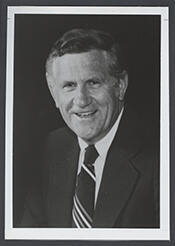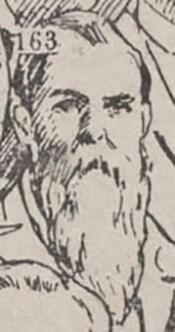
Grove Lawrence Johnson (March 27, 1841 – February 1, 1926) was an American attorney and Republican politician from California who served in both houses of the California legislature and as a United States Representative. He was the father of Hiram Warren Johnson, who later became a United States Senator and a prominent Progressive-era political figure. Over the course of a long public career, Grove L. Johnson was closely identified with the politics of Sacramento and with the development of the Republican Party in California in the late nineteenth and early twentieth centuries.
Johnson’s service in the United States Congress occurred during a significant period in American history marked by economic and political realignments following the Panic of 1893 and during the presidency of Grover Cleveland. A member of the Republican Party, he was elected as a Representative from California and served one term in the House of Representatives from 1895 to 1897. During this term in office he participated in the legislative process and represented the interests of his California constituents in national debates, contributing to the work of the Fifty-fourth Congress. His tenure in Congress was his highest federal office and formed part of a broader career that included extensive state legislative service.
After losing reelection to Congress, Johnson resumed the practice of law in Sacramento, California, where he had long been active as an attorney and political figure. He quickly returned to state politics and, in 1898, was again elected to the California Assembly. He served in the Assembly from 1899 to 1905, participating in legislative deliberations during a period of rapid growth and change in California. He sought another term in 1904 but was defeated in his bid for reelection. Undeterred, Johnson remained a presence in Republican politics, and in 1906 he was elected to another term in the California Assembly, serving from 1907 to 1911. He again stood for reelection in 1910 but lost his campaign, bringing to a close his final period of continuous legislative service.
In addition to his work in elective office, Johnson held a federal administrative post later in life. In 1921 he was appointed Receiver of Public Moneys at the United States Land Office in Sacramento, a position that placed him at the center of federal land and resource administration in the region. He served in this capacity until 1925, when the position was eliminated as part of changes in federal land management. This appointment extended his public service into the early 1920s and reflected his longstanding connections within Republican and governmental circles.
In his personal life, Johnson married Mabel Ann Williamson De Montfredy in 1846. She was a native of Onondaga County, New York, and her mother was a member of the Van Cortlandt family, one of the early Dutch settler families of New York. Grove and Mabel Johnson were the parents of three daughters and two sons, including Hiram W. Johnson, whose own political career would carry the family name into national prominence. The Johnson household thus combined established New York colonial lineage with the emerging political culture of the American West.
Grove Lawrence Johnson remained in Sacramento during his later years, continuing to be identified with the city’s legal and political life even after his formal public duties ended. He died on February 1, 1926. His career, spanning state and federal office and culminating in a late-life federal appointment, reflected the trajectory of many nineteenth-century lawyers who helped shape both local and national institutions during a period of significant transformation in California and the United States.
Congressional Record