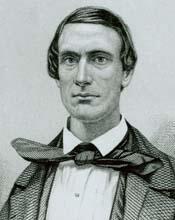
Green Adams (August 20, 1812 – January 18, 1884) was an American politician, lawyer, and jurist who represented Kentucky in the United States House of Representatives during two nonconsecutive terms between 1847 and 1861. Over the course of his national service he was affiliated with the Whig Party, the Opposition Party, and is also recorded as having served as a member of the Independent Party, reflecting the shifting partisan alignments of the mid-nineteenth century. His congressional tenure coincided with a critical period in American history leading up to the Civil War, during which he participated in the legislative process and represented the interests of his Kentucky constituents.
Adams was born in Barbourville, Knox County, Kentucky, on August 20, 1812. He spent his early years engaged in agricultural pursuits and worked as a farmer before turning to the study of law. After reading law, he was admitted to the bar and commenced practice, establishing himself in the legal profession in his native state. Early in his public life, he served as deputy sheriff of Knox County from 1832 to 1833, gaining experience in local administration and law enforcement that would inform his later political and judicial career.
Adams entered elective office in 1839, when he was chosen as a member of the Kentucky House of Representatives. His service in the state legislature marked his formal entry into politics and aligned him with the Whig Party, which was then a dominant force in Kentucky. In 1844 he further demonstrated his standing within the Whig ranks by serving as a presidential elector on the Whig ticket, participating in the national electoral process and helping to advance the party’s national candidates.
In 1847 Adams was elected as a Whig to the United States House of Representatives from Kentucky, serving in the Thirtieth Congress from 1847 to 1849. During this first term in Congress he contributed to the legislative work of the House at a time when the nation was grappling with the consequences of the Mexican–American War and the expansion of slavery into new territories. After leaving Congress, he returned to Kentucky and, in 1851, was appointed a judge of the Kentucky Circuit Court. He held this judicial post from 1851 to 1856, presiding over a broad range of civil and criminal matters and reinforcing his reputation as a capable lawyer and jurist.
Adams reentered national politics in the late 1850s. In 1859 he was elected again to the U.S. House of Representatives, this time as a member of the Opposition Party, a coalition that drew many former Whigs and other anti-Democratic elements. He served in the Thirty-sixth Congress from 1859 to 1861. His congressional service thus spanned two distinct periods, from 1847 to 1849 and from 1859 to 1861, and is also described as encompassing service from 1847 to 1861 as a Representative from Kentucky, reflecting his role across these pivotal years. During this later term, as the secession crisis deepened following the withdrawal of South Carolina from the Union but before the inauguration of President Abraham Lincoln, the House of Representatives considered measures to coerce seceded states back into the Union. Although a slave owner, Adams was one of the very few congressmen from the Southern states to support coercive efforts to preserve the Union, a stance he shared among Southern representatives chiefly with Henry Winter Davis of Baltimore. His position placed him at odds with many of his regional colleagues and underscored his commitment to the integrity of the United States.
With the outbreak of the Civil War and the advent of the Lincoln administration, Adams moved into federal executive service. In 1861 he was appointed the sixth auditor of the United States Treasury Department, a position he held until 1864. In this capacity he oversaw important financial and accounting functions during a period of extraordinary fiscal demands on the federal government. After leaving the auditor’s office, he continued his association with the federal government and, from 1875 to 1881, served as disbursing clerk for the United States House of Representatives, managing the distribution of funds and further extending his long career in public service.
In his later years Adams practiced law in Philadelphia, Pennsylvania, where he continued his legal career away from his native Kentucky. He remained in Philadelphia until his death on January 18, 1884. Green Adams was interred at West Laurel Hill Cemetery in Bala Cynwyd, Pennsylvania, closing a life that encompassed service as a state legislator, congressman, circuit court judge, federal auditor, and senior House official during some of the most consequential decades in American history.
Congressional Record