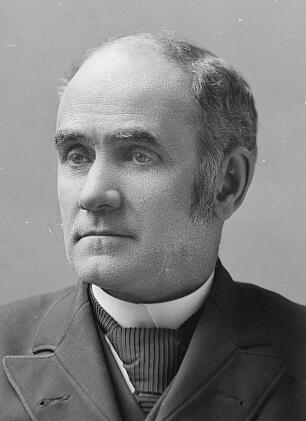
Gilbert Lafayette Laws (March 11, 1838 – April 25, 1907) was an American politician, newspaper publisher, businessman, and Civil War veteran who served as Nebraska secretary of state and as a Republican Representative from Nebraska in the United States Congress from 1889 to 1891. Born on a farm near Olney, Illinois, he was the son of James Laws and Lucinda (Calhoun) Laws. In 1845, he moved with his parents to Iowa County, Wisconsin, where he was raised in a rural setting that would shape his early work and educational opportunities.
Laws pursued his education at Haskell University and Milton College in Wisconsin, financing his studies by working in the lumber business during the summers. After completing his education, he taught school in Richland Center, Wisconsin, continuing in that profession until 1861. His early career as a teacher reflected both his commitment to self-improvement and his engagement with the developing communities of the upper Midwest on the eve of the American Civil War.
With the outbreak of the Civil War, Laws enlisted in the 5th Wisconsin Infantry Regiment. His military service was cut short when he was severely wounded at the Battle of Williamsburg on May 5, 1862, resulting in the amputation of his left leg below the knee. He was discharged from the Union Army in July 1862 and returned to civilian life in Richland County, Wisconsin. Despite his disability, he quickly reentered public life and business, demonstrating resilience and a capacity for leadership.
Laws was elected Richland County clerk in 1862 and was reelected twice, serving in that office while also entering the newspaper business. During his tenure as county clerk, he published the Republican newspaper the Richland County Observer, which aligned him with the emerging Republican Party and its policies during and after the Civil War. After selling his share of the newspaper in 1864, he turned to manufacturing, producing lumber, wagon materials, and bedsteads. He became increasingly active in local government, serving on the Richland Center city council in 1868 and 1869 and as mayor of Richland Center in 1869. He also chaired the Richland County board of supervisors in 1869 and 1870 and served as postmaster from 1866 to 1876. In 1876, he resigned his posts and moved west to Orleans, Nebraska, as part of the broader migration and development of the Great Plains.
In Nebraska, Laws continued his public service and administrative career. In 1883, he was appointed register of the United States General Land Office in McCook, Nebraska, a position of importance in managing federal lands during a period of rapid settlement. He held that office until November 1, 1886, when he was elected secretary of state of Nebraska. As Nebraska secretary of state, he served from 1886 until 1888, overseeing state records and elections and further solidifying his standing within the Republican Party and the political life of the state.
Laws’s congressional service came during a significant period in American history, marked by economic growth, western expansion, and debates over federal policy. Elected as a Republican to the Fifty-first Congress to fill the vacancy caused by the death of Representative James Laird, he represented Nebraska’s 2nd congressional district in the United States House of Representatives from December 2, 1889, to March 3, 1891. During his single term in office, he participated in the legislative process and represented the interests of his Nebraska constituents as a member of the House of Representatives. Although he served only one term, his tenure placed him within the broader national dialogue on issues affecting the rapidly developing western states and territories. He did not run for reelection at the conclusion of his term.
After leaving Congress, Laws moved to Enid, in what would become Oklahoma, where he engaged in the real estate business, reflecting the ongoing opportunities in land and town development in the region. In 1895, he returned to Lincoln, Nebraska, where he resumed public service as secretary of the State Board of Transportation from 1896 to 1900, contributing to the regulation and oversight of transportation at a time when railroads and related infrastructure were central to Nebraska’s economy and growth.
On October 25, 1868, Laws had married Josephine Lawrence, and the couple had three daughters: Gertrude H. Laws, Theodosia C. Laws, and Helen Lucile Laws. He spent his later years in Lincoln, Nebraska, where he remained a respected figure due to his long record of military service, local and state office, and national legislative experience. Gilbert Lafayette Laws died in Lincoln on April 25, 1907, at the age of 69 years and 45 days. He was interred at Wyuka Cemetery in Lincoln, Nebraska, closing a life that spanned frontier settlement, civil war, Reconstruction, and the maturation of Nebraska as a state.
Congressional Record