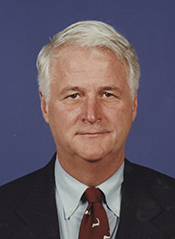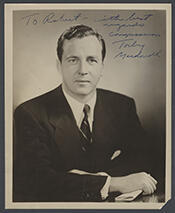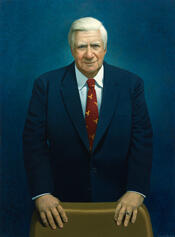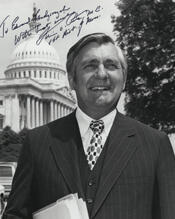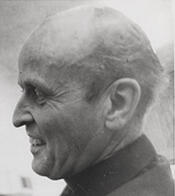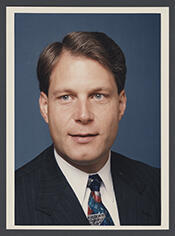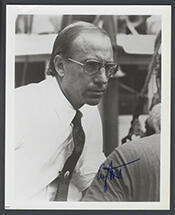
Gerry Eastman Studds (GHERR-ee; May 12, 1937 – October 14, 2006) was an American Democratic Congressman from Massachusetts who served in the United States House of Representatives from 1973 until 1997. Over the course of 12 consecutive terms, he represented first Massachusetts’s 12th congressional district and, after redistricting in 1983, the 10th congressional district. He was the first member of Congress to be openly gay and became a prominent advocate for environmental protection, maritime policy, civil rights, and AIDS funding. His long career in public life was also marked by controversy, including a formal censure by the House of Representatives in 1983 for a sexual relationship with a 17-year-old congressional page.
Studds was born on May 12, 1937, in Mineola, New York, to Elbridge Gerry Eastman Studds, an architect who helped design the Franklin D. Roosevelt Drive in New York City, and Beatrice (Murphy) Studds. He had a brother, Colin Studds, and a sister, Gaynor (Studds) Stewart. Through his father’s line, he was a direct descendant of Elbridge Gerry, the early American statesman who served as vice president of the United States and governor of Massachusetts in the 1810s. This family connection to a prominent figure in early American politics foreshadowed Studds’s own eventual career in national public service.
Studds attended Yale University on a full scholarship, earning a bachelor’s degree in history in 1959 and a master’s degree in 1961. While at Yale, he was a member of the literary and social society St. Anthony Hall. After completing his graduate studies, he entered the United States Foreign Service and later worked in the administration of President John F. Kennedy. In the Kennedy White House he was involved in the early development of the Peace Corps, contributing to one of the administration’s signature international service initiatives and gaining experience in federal policymaking and international affairs.
From 1965 to 1969, Studds taught history and politics at St. Paul’s School, a preparatory school in Concord, New Hampshire. He quickly became a focal point for progressive students; the school’s official history later described him as “a lightning rod for student discontent.” Under his guidance, 182 upperclassmen signed a letter to the school’s conservative administration demanding reforms, including a de-emphasis on athletics, an end to mandatory Sunday chapel attendance, and broader institutional changes. St. Paul’s ultimately implemented many of these demands, including eventually admitting female students. In 1969, however, the school encouraged Studds to leave under circumstances that were long publicly attributed to his anti-establishment views, and it paid for him to attend the Harvard Graduate School of Education. Decades later, a 2018 investigative report commissioned by St. Paul’s School on faculty-student sexual misconduct cited former students who described “questionable encounters” with Studds and relayed an unconfirmed claim that he had been fired for inappropriate conduct with students. Another alumnus filed a lawsuit in 2018 alleging additional, more serious misconduct. A posthumous biography of Studds, published before the report, noted that he had acknowledged dealing with students “in ways that were human but neither professional nor responsible.”
Studds’s entry into electoral politics was closely tied to his opposition to the Vietnam War. While still teaching at St. Paul’s, he played a key role in the 1968 presidential campaign by persuading anti-war Senator Eugene McCarthy to challenge President Lyndon B. Johnson in the New Hampshire Democratic primary. Despite the school’s refusal to grant him a leave of absence, Studds ran McCarthy’s New Hampshire operation. McCarthy’s strong showing—he narrowly lost to Johnson—exposed the president’s political vulnerability and helped prompt Senator Robert F. Kennedy to enter the race four days later, a development that contributed to Johnson’s subsequent decision not to seek re-election. This experience solidified Studds’s commitment to public service and set the stage for his own campaigns for office.
Studds first ran for Congress in 1970, seeking election in Massachusetts’s 12th congressional district. He narrowly lost to the Republican incumbent, Hastings Keith. Following redistricting that forced Keith to retire before the 1972 election, Studds ran again and won, defeating Republican William D. Weeks by a margin of just 1,118 votes. He took office on January 3, 1973. Rumors about his sexual orientation surfaced during his 1978 re-election campaign, but he prevailed at the polls and continued to consolidate his political base. After another round of redistricting in 1983, he was transferred to represent Massachusetts’s 10th congressional district, which included coastal communities and the gay enclaves of Martha’s Vineyard and Provincetown, and he served in that district until his retirement in 1997.
During his 24 years in the House of Representatives, Studds became a significant figure in maritime and environmental policy and a consistent voice on foreign affairs and civil rights. He was particularly active on issues affecting the New England fishing industry and the broader U.S. maritime economy. In the 1970s he played a leading role in drafting legislation that effectively banned foreign fishing vessels from operating within 200 miles of the U.S. coastline, a measure that helped protect domestic fisheries and that “largely” originated with his efforts. The bill’s co-author, Representative Don Young of Alaska, a conservative Republican, later credited Studds’s work and maintained a close friendship with him despite their ideological differences, remarking that he “hate[d] homosexuals and eastern liberals, but not Mr. Studds.” Studds also authored the National Marine Sanctuaries Reauthorization and Improvement Act of 1992, strengthening protections for key marine habitats, and in 1992 he rose to become chairman of the full House Committee on Merchant Marine and Fisheries after previously chairing one of its subcommittees.
Studds’s congressional career was indelibly marked by the 1983 House page sex scandal. That year, the House Ethics Committee investigated allegations that both Studds and Representative Dan Crane had engaged in sexual relationships with teenage congressional pages a decade earlier. In Studds’s case, the committee found that he had a sexual relationship in 1973 with a 17-year-old male page and that he had made sexual advances toward two other male pages, which he confirmed. During the investigation, Studds publicly acknowledged his homosexuality, thereby becoming the first openly gay member of Congress. In a floor speech, he reflected on the difficulty of balancing public and private life, stating that such challenges were “substantially more complex when one is, as I am, both an elected public official and gay.” Although he disagreed with the committee’s findings of improper sexual conduct, he waived his right to a public hearing, saying that the decision “presented me with the most difficult choice I have had to make in my life,” in order, he said, to protect the privacy of those involved.
On July 20, 1983, after the Ethics Committee initially recommended a reprimand, the full House voted 338–87 to increase the penalty to censure, and then voted 420–3 to formally censure Studds. The three “no” votes were cast by Representatives Bill Clay, Mervyn Dymally, and Parren Mitchell. Studds defended the 1973 relationship as a “mutually voluntary, private relationship between adults,” while acknowledging that it was inappropriate for a Member of Congress to engage in a sexual relationship with a subordinate and calling it “a very serious error in judgment.” He later described it as “a damn stupid and inappropriate thing to do, and I never said it wasn’t.” The former page testified that the relationship made him “somewhat uncomfortable” and that he would rather have had the friendship without the sexual component, but he also stated that the experience was not “destructive or painful” and that Studds had neither offered inducements for sex nor prevented him from ending the relationship. After Studds’s death, his widower, Dean Hara, said that Studds had never been ashamed of the relationship. Although Studds lost his subcommittee chairmanship on the Merchant Marine and Fisheries Committee as a result of the scandal, the setback proved temporary. Many constituents in his coastal district, where his sexuality was reportedly “not news,” continued to support him; he received two standing ovations at his first town meeting after the censure and went on to win re-election six more times.
In the years following the scandal, Studds deepened his legislative focus on environmental protection, maritime affairs, and civil rights. Representing a district with a large fishing industry, he consistently backed protectionist policies for local fishermen and worked to balance economic interests with conservation measures. He was a vocal supporter of increased federal funding for AIDS research and treatment during the height of the epidemic, and he became an important advocate for gay and lesbian rights in Congress. In 1994 he joined Senator Edward M. Kennedy in introducing legislation to prohibit employment discrimination based on sexual orientation, an early forerunner of later federal efforts to expand workplace civil rights protections. In foreign and defense policy, he remained aligned with the anti-war convictions that had drawn him into politics, speaking out against the Reagan administration’s Strategic Defense Initiative missile defense program and criticizing the U.S. government’s covert support for the Contra forces in Nicaragua.
Studds retired from Congress at the conclusion of his 12th term on January 3, 1997, ending nearly a quarter-century of continuous service. After leaving office, he worked as a lobbyist for the fishing industry, drawing on his long experience with maritime policy and coastal economic issues. He also served as executive director of the New Bedford Oceanarium project (often referred to as the New Bedford Aquarium), an initiative intended to promote marine education and regional economic development in the historic whaling port of New Bedford, Massachusetts. His post-congressional career thus continued his longstanding engagement with ocean policy and coastal communities.
In his personal life, Studds entered into a relationship with Dean T. Hara in 1991. The couple married in Boston on May 24, 2004, one week after Massachusetts became the first state in the nation to legalize same-sex marriage. On October 14, 2006, Studds died at age 69 from complications of a pulmonary embolism. Because of the federal Defense of Marriage Act’s then-operative ban on recognizing same-sex marriages for federal purposes, Hara was deemed ineligible to receive the congressional survivor’s pension normally provided to the spouses of former Members of Congress. Hara subsequently became a plaintiff in Gill v. Office of Personnel Management, a landmark lawsuit that successfully challenged the constitutionality of Section 3 of the Defense of Marriage Act, contributing to the broader legal transformation of federal recognition of same-sex marriages.
Studds’s legacy has been recognized in several ways. When he retired from Congress, his longtime colleague and friend Don Young sponsored legislation to name the Stellwagen Bank National Marine Sanctuary, located at the mouth of Massachusetts Bay, in his honor, reflecting Studds’s central role in marine conservation policy. In August 2019, he was added to the Rainbow Honor Walk in San Francisco’s Castro neighborhood, a walk of fame honoring LGBTQ individuals who have made significant contributions in their fields. His career, which spanned a transformative period in American politics from the early 1970s through the 1990s, remains notable both for his legislative achievements and for his role as a pioneering, openly gay member of Congress who navigated public scandal, changing social norms, and the evolving landscape of civil rights in the United States.
Congressional Record