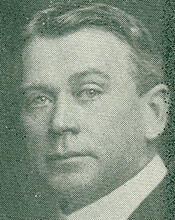
George Austin Welsh (August 9, 1878 – October 22, 1970) was a United States representative from Pennsylvania and a United States district judge of the United States District Court for the Eastern District of Pennsylvania. A member of the Republican Party, he served five terms in the United States House of Representatives from 1923 to 1933, and later held a long tenure on the federal bench. His congressional service and judicial career spanned a significant period in American history, encompassing the post–World War I era, the Roaring Twenties, the onset of the Great Depression, and the mid‑twentieth century.
Welsh was born on August 9, 1878, in Bay View, Maryland. He attended country schools there before moving to Philadelphia, Pennsylvania, where he continued his education in the city’s public schools. He pursued both business and academic courses at Temple University, then known as Temple College, while supporting himself as a legislative stenographer and reporter from 1895 to 1901. He received a Bachelor of Laws degree in 1905 from the Philadelphia Law School of Temple College (now the Temple University Beasley School of Law) and was admitted to the bar that same year, marking the beginning of a legal career closely intertwined with the civic and political life of Philadelphia.
Upon admission to the bar, Welsh entered private practice in Philadelphia, where he practiced law from 1905 to 1923. Almost immediately he combined private practice with public service. From 1905 to 1906 he served as secretary to Philadelphia Mayor John Weaver, gaining early experience in municipal administration. He then became an assistant city solicitor for Philadelphia from 1906 to 1907, followed by a lengthy tenure as an assistant district attorney in Philadelphia from 1907 to 1922. During these years he also began to emerge as a figure in Republican politics and in educational governance. He served as president of the Republican district executive committee from 1914 to 1932, and from 1921 to 1932 he was a member of the Board of Education of Philadelphia County, Pennsylvania, reflecting his growing influence in both political and educational affairs. In 1917, during World War I, he attended officers’ training camp at Fort Niagara, New York, demonstrating his participation in national preparedness efforts.
Welsh maintained a close and enduring relationship with Temple University alongside his legal and political work. He became secretary of Temple University in 1914, a position he held until 1938, playing a key role in the institution’s administration during a period of expansion and professionalization. In 1938 he was appointed the university’s first vice president, formalizing his senior leadership role in the governance of the institution. His dual engagement in higher education and public service underscored his long-standing commitment to civic improvement and educational opportunity in Philadelphia.
In national politics, Welsh was elected as a Republican to the United States House of Representatives for the 68th Congress and was reelected to the four succeeding Congresses, serving from March 4, 1923, until his resignation on May 31, 1932. During his five terms in office, he represented the interests of his Pennsylvania constituents and contributed to the legislative process at a time marked by economic growth in the 1920s and the early years of the Great Depression. In the 69th Congress he served as chairman of the Committee on Industrial Arts and Expositions, a position that involved oversight of legislation related to expositions and the promotion of industrial and artistic achievements. His decade in the House placed him at the center of national debates over economic policy, infrastructure, and social change in the interwar period.
Welsh’s congressional service concluded when he was elevated to the federal judiciary. On April 14, 1932, President Herbert Hoover nominated him to a seat on the United States District Court for the Eastern District of Pennsylvania, vacated by Judge Joseph Whitaker Thompson. The United States Senate confirmed his nomination on May 19, 1932, and he received his commission on May 20, 1932. He resigned from Congress effective May 31, 1932, to assume his judicial duties. As a United States district judge, Welsh presided over federal trial matters in a jurisdiction that included Philadelphia and surrounding counties, serving through decades of legal and social transformation. He assumed senior status on August 29, 1957, continuing to hear cases with a reduced docket while remaining an active presence on the court.
In his personal life, Welsh married Nellie Ross Wolf of Bermuda in 1906, and they had two sons, William Austin Welsh and James Conwell Welsh. In 1921 he married for the second time, to Helen Reed Kirk, with whom he had three children: Margaret, Patrick, and Deborah. His family life unfolded alongside his extensive commitments to law, politics, and education in Philadelphia and the broader Pennsylvania community.
George Austin Welsh resided in Media, Pennsylvania, during his later years. His service on the federal bench ended with his death on October 22, 1970, in Media. He was cremated, and his ashes were interred in West Laurel Hill Cemetery in Bala Cynwyd, Pennsylvania. His long career as a lawyer, legislator, educator, and federal judge left a sustained imprint on both the civic institutions of Philadelphia and the federal judiciary of the Eastern District of Pennsylvania.
Congressional Record