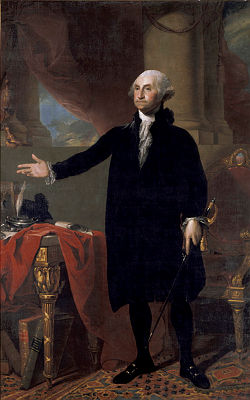
On February 22, 1732, George was born to Augustine and Mary Ball Washington. He spent most of his childhood at Ferry Farm on the Rappahannock River. All of the homes and plantations where Washington lived were maintained by enslaved labor. When George was eleven, his father died and he became a slave owner. As a result, George did not receive a formal education like his older half-brothers. Instead, he helped his mother on the farm and attended a local school in Fredericksburg. For the rest of his life, Washington supplemented his education with reading and self-guided study. At seventeen-years old, George used his family connections to secure appointment as the surveyor for Culpeper County.
This position offered adventure, a steady income, and the opportunity to view and purchase unclaimed land. His surveying experience also instilled in George a firm conviction in the importance of westward expansion to the future of the colonies, and later the United States. In 1753, Lieutenant Governor of Virginia Robert Dinwiddie sent twenty-one-year-old Washington, now a Major in the Virginia Regiment, to deliver a message to the French, demanding they abandon the Ohio Valley. Washington later published his account of the trip, giving him an international reputation. A few months later, Washington again marched out west with 150 men to enforce Virginia’s claim. The mission ended in a humiliating surrender at Fort Necessity, followed by Washington’s resignation of his commission. Two years later, Washington again witnessed fighting in the Ohio Country, this time as an aide-de-camp in British General Edward Braddock’s official family. Braddock’s army suffered an overwhelming defeat near the Monongahela River, but Washington was commended for rallying the survivors in the face of chaos. On January 6, 1758, George married Martha Dandridge Custis, a beautiful and charming widow from Virginia. George acquired significant wealth and a partner for the next four decades through the marriage.
Between 1759 and 1775, George served many terms in the Virginia House of Burgesses and devoted himself to improving farming practices at his plantation through the labor of the growing enslaved community. After supporting the colonies’ protests against British tax measures in the 1770s, Washington was appointed Commander-in-Chief of the Continental Army by Congress in June 1775. For the next eight years, Washington remained with the army, only leaving camp to attend summons by Congress. Under Washington’s command, the Continental Army lost more battles than it won, constantly struggling to obtain the necessary food, supplies, and ammunition.
But the army persisted–and the colonies’ fight for independence could not be extinguished. Washington also served a critical role ensuring that military power remained subordinate to civilian government. He never used his authority to challenge Congress and ended potential military coups within the army’s ranks. When the Treaty of Paris ended the Revolutionary War, Washington resigned his commission to Congress. Washington’s relinquishing of power was nearly unprecedented and made him an international hero. In 1787, Washington was again called to serve when Virginia appointed him as a delegate to the Constitutional Convention. The delegates crafted a Constitution that created a government with significantly more authority and centralized power.
They hoped the new government would address the economic, diplomatic, and domestic calamities that had besieged the nation for over a decade under the Articles of Confederation. Unsurprisingly, the delegates trusted Washington with the presidency. To this day, he is the only president to be unanimously elected. On April 16, 1789, George Washington left his home at Mount Vernon to travel to New York City to be inaugurated as the first President of the United States. During Washington’s presidency, at least ten enslaved people worked at the president’s houses in New York City and Philadelphia: Ona, Hercules, Moll, Giles, Austin, Richmond, Paris, Joe, Christopher Sheels, and William Lee. They tended the horses and carriages in the stables, escorted Washington and his family when they left the house, cooked in the kitchen, did laundry, cleaned the home, cared for the Washingtons’ grandchildren, helped the Washingtons dress in the morning, greeted guests, and more. Click here to learn more about the enslaved household of President George Washington. During Washington’s presidency, he established countless precedents that guided his successors, including creating the president’s cabinet, asserting executive privilege, and using the veto for the first time. He also expanded executive authority over diplomatic and domestic issues, crafting foreign policy during the Neutrality Crisis in 1793 and subduing the Whiskey Rebellion in 1794. Perhaps most importantly, Washington again relinquished his power when he retired after two terms in office. This precedent was reinforced by Thomas Jefferson and followed by every successive president until Franklin D. Roosevelt. In 1951, the states ratified the 22 nd Amendment, which limits presidents to two terms in office. After retiring from public office, Washington returned to Mount Vernon for a few short years. On December 14, 1799, Washington died of a throat infection. His will included a provision to immediately free William Lee, his enslaved valet who served with him during the American Revolution. He also stipulated that the other 122 enslaved people owned by him receive their freedom upon Martha’s passing. While Washington was a slave owner for 56 years, he was the only Founding Father president to free all of the enslaved people he held in bondage.