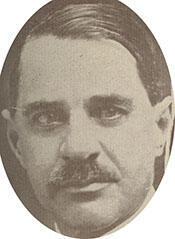
George Edward Wales (May 13, 1792 – January 8, 1860) was an American politician and lawyer from Vermont who served as a U.S. Representative. He was born in Westminster, Vermont, where he attended the common schools. As a young man he pursued legal studies, reading law under Stephen R. Bradley in Westminster and later under Titus Hutchinson in Woodstock; Hutchinson would subsequently become chief justice of the Vermont Supreme Court. Wales was admitted to the bar in 1812, marking the formal beginning of his legal career.
In 1813 Wales moved to Hartford, Vermont, where he established his law practice and became an active figure in local affairs. That same year he married Amanda Lathrop, and the couple eventually had seven children. Alongside his legal work, he became involved in business enterprises, serving as clerk and treasurer of the White River Bridge Company from 1818 until 1825, a role that reflected his engagement with the region’s developing transportation infrastructure. His growing prominence in the community was further evidenced by his participation in civic and fraternal organizations; he joined the Free and Accepted Masons of the State of Vermont in 1812 and later served as the state Grand Master from 1825 to 1827.
Wales’s political career began in the Vermont House of Representatives, where he served as a member from 1822 until 1824. During each of those three years—1822, 1823, and 1824—he was chosen Speaker of the House, underscoring the confidence his colleagues placed in his leadership and parliamentary skills. His public reputation was also recognized in the academic sphere: Dartmouth College awarded him an honorary degree in 1823, and the University of Vermont conferred an honorary degree in 1825, reflecting his standing as a lawyer and public servant in the state.
At the national level, Wales was elected to the United States House of Representatives as a member of the Adams Party, also known as the National Republican Party. He represented Vermont in the Nineteenth and Twentieth Congresses, serving from March 4, 1825, to March 3, 1829. During these two terms in office, he contributed to the legislative process in a period of significant political realignment in the early republic, participating in the democratic process and representing the interests of his Vermont constituents. He stood for reelection in 1828 as a National Republican but was an unsuccessful candidate for the Twenty-First Congress, bringing his congressional service to a close after four years.
Following his departure from Congress, Wales returned to Hartford and resumed the practice of law, continuing his long association with the legal profession. As national party structures evolved, he later affiliated with the Whig Party, aligning himself with the principal opposition to Jacksonian Democracy in the 1830s and 1840s. His commitment to public service remained strong at the local level. In 1840 he was elected town clerk of Hartford, a position he held continuously until his death, managing the town’s records and administrative affairs over two decades.
In addition to his local responsibilities, Wales held important judicial and educational posts. From 1847 to 1850 he served as judge of the Probate Court for the district that included Windsor County, overseeing matters of estates, guardianships, and related legal proceedings. He was also a trustee of Norwich University from 1845 until 1857, contributing to the governance of one of Vermont’s key educational institutions during a formative period in its history. These roles reflected his stature as a respected lawyer, jurist, and civic leader.
George Edward Wales died in Hartford, Vermont, on January 8, 1860, while still serving as town clerk. His life encompassed significant service at the local, state, and national levels, including leadership in the Vermont legislature, two terms in the U.S. House of Representatives as a member of the Adams (National Republican) Party, and later affiliation with the Whig Party. Through his legal practice, public offices, Masonic leadership, and involvement with institutions such as Norwich University, he played a notable role in the civic and political life of Vermont in the first half of the nineteenth century.
Congressional Record