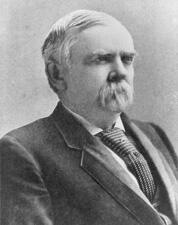
George Graham Vest (December 6, 1830 – August 9, 1904) was an American lawyer and politician who served as a Missouri state legislator, a member of the Confederate Congress, and a United States Senator from Missouri. Born in Frankfort, Franklin County, Kentucky, he was widely known for his skills in oration and debate and would become nationally famous for his “man’s best friend” courtroom summation in the Old Drum dog case. A member of the Democratic Party, he served four terms in the United States Senate from 1879 to 1903, representing Missouri during a significant period in American political and social history.
Vest was educated in Kentucky, graduating from Centre College in Danville in 1848. He then studied law at Transylvania University in Lexington, Kentucky, receiving his law degree in 1853. Admitted to the bar that same year, he initially planned to move to California, but while traveling west he stopped in Pettis County, Missouri. There he defended a young African-American man accused of murder. Although Vest secured an acquittal, the man was seized by a mob and burned at the stake, and Vest himself was threatened. Despite this violent episode, he chose to remain in Missouri and settled in Georgetown, Pettis County. In 1854 he married Sallie Sneed of Danville, Kentucky; the couple had three children, two sons and a daughter.
By 1860 Vest had moved to Boonville, Missouri, and entered public life. That year he was elected to the Missouri House of Representatives and also served as a Democratic presidential elector. In the state legislature he became chairman of the Committee on Federal Relations and emerged as a strong proponent of Southern rights. During the Missouri secession crisis at the outset of the Civil War, he was a forceful advocate of maintaining slavery and denounced federal “coercion” of the Southern states. He authored the so‑called Vest Resolutions, which condemned the use of force against the seceding states, and he proposed the Secession Ordinance that was passed by the pro-Confederate Missouri legislature in October 1861.
With the outbreak of the Civil War, Vest cast his lot with the Confederacy. In 1862 he briefly served as judge advocate with the Army of Missouri under former Governor Sterling Price. He then entered the Confederate national legislature, serving in the House of Representatives of the Confederate Congress from February 1862 until January 12, 1865. On that date he resigned his House seat after being appointed to fill a vacancy in the Confederate Senate, where he served during the final months of the Confederacy. His wartime service placed him among the leading Missouri Confederates and later made him, by the end of his life, the last surviving former Confederate States Senator.
After the Civil War, Vest returned to Pettis County and settled in Sedalia, Missouri, where he resumed the practice of law. It was during this postwar legal career that he took on the case that would secure his lasting popular fame. On September 23, 1870, he represented Charles Burden in a suit for damages against Leonidas Hornsby, a sheep farmer and Burden’s brother‑in‑law, who had killed Burden’s hunting dog, a foxhound named Drum, or “Old Drum,” after announcing he would shoot any dog found on his property. Burden sought $150 in damages, the maximum allowed by law. Vest, vowing that he would “win the case or apologize to every dog in Missouri,” delivered a closing argument that ignored the trial testimony and instead offered an eloquent tribute to the loyalty and constancy of the dog as “the one absolutely unselfish friend that a man can have in this selfish world.” His “Eulogy of the Dog,” which described the dog’s fidelity in prosperity and poverty, in life and at his master’s grave, became one of the most celebrated passages of courtroom oratory in American history. Vest won the case; the jury awarded $50 in damages, and the judgment was upheld by the Missouri Supreme Court. A bust of Old Drum was later placed in the Missouri Supreme Court building in Jefferson City, and in 1958 a statue of the dog, bearing a summation of Vest’s words that “a man’s best friend is his dog,” was erected on the Johnson County Courthouse lawn.
In 1877 Vest moved to Kansas City, Missouri, and soon shifted his focus from law back to politics. In 1879 he was elected as a Democrat to the United States Senate from Missouri. He was re‑elected in 1885, 1891, and 1897, serving four consecutive terms from March 4, 1879, to March 4, 1903. During this long tenure he contributed to the legislative process in an era marked by Reconstruction’s aftermath, industrial expansion, and the rise of regulatory and conservation issues. In the Senate he held several important committee assignments, including chairman of the Committee on Public Buildings and Grounds during the Fifty‑third Congress. He also served on the Committee on Epidemic Diseases in the Fifty‑fourth Congress and on the Committee on Public Health and National Quarantine from the Fifty‑fourth through the Fifty‑seventh Congresses, reflecting his involvement in public health and infrastructure concerns.
Vest’s Senate career was also notable for his early and vigorous advocacy of federal oversight and conservation in the national parks. In 1882 he became aware of abuses and potential monopolistic practices in the granting of concessions in Yellowstone National Park, particularly by railroad interests and other businessmen seeking largely unchecked control over park resources and facilities. Alarmed by these developments, he introduced and helped secure passage of legislation requiring the Secretary of the Interior to submit concession and construction contracts in Yellowstone to the Senate for review. This measure imposed a new layer of congressional oversight that curtailed corruption and speculative abuses in the park. Because of his persistent efforts on behalf of Yellowstone, Vest became known as the “self‑appointed protector of Yellowstone National Park,” an early example of congressional involvement in conservation policy.
By the early twentieth century, Vest’s health began to fail, and he chose not to seek another term. He retired from the Senate on March 4, 1903, after twenty‑four years of continuous service, and withdrew from active public life. On August 9, 1904, he died at his summer home in Sweet Springs, Missouri. At the time of his death he was recognized as the last living former Confederate States Senator. George Graham Vest was buried in Bellefontaine Cemetery in St. Louis, Missouri, leaving a legacy as a powerful orator, a long‑serving Democratic senator from Missouri, and an early congressional advocate for the protection of Yellowstone National Park.
Congressional Record