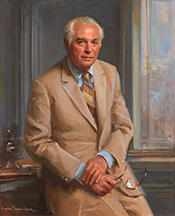
George Herbert Utter (July 24, 1854 – November 3, 1912) was a Republican politician who served as a U.S. Representative from Rhode Island from 1911 to 1913 and as the forty‑ninth governor of Rhode Island. Over the course of a long public career, he held a succession of state offices before entering the United States Congress, where he represented the interests of his constituents during a significant period in American political life.
Utter was born in Plainfield, New Jersey, on July 24, 1854. In 1861 he moved with his parents to Westerly, Rhode Island, where he was raised. He attended the public schools of Westerly and later pursued further studies at Alfred Academy in Alfred, New York. Demonstrating early academic promise, he went on to Amherst College in Massachusetts, from which he graduated in 1877. His education provided a foundation for his later work in publishing and public service.
After completing his studies, Utter settled in Westerly and engaged in the printing and publishing business. He became the printer and publisher of the Westerly Sun, a local newspaper that helped establish his prominence in the community and connected him with public affairs. His involvement in journalism and local civic life led to opportunities in state politics, and he soon began a steady rise through Rhode Island’s political ranks.
Utter’s formal political career began when he served as a personal aide on the staff of Governor Augustus O. Bourn from 1883 to 1885. He was then elected to the Rhode Island House of Representatives, where he served from 1885 to 1889, acting as speaker of the House during his final year in that body. He subsequently held a series of statewide executive offices. Utter served as Secretary of State of Rhode Island from 1891 to 1894, overseeing the state’s official records and elections. A decade later he was elected lieutenant governor in 1904, and he advanced to become the forty‑ninth governor of Rhode Island, serving from 1905 to 1906. In recognition of his standing in public life, he was elected an honorary member of the Rhode Island Society of the Cincinnati in 1907.
Building on his state-level experience, Utter was elected as a Republican to the Sixty‑second Congress. He took his seat in the U.S. House of Representatives on March 4, 1911, representing Rhode Island as a member of the Republican Party. His term in Congress, which ran from 1911 to 1913, coincided with a period of significant national debate over economic regulation, political reform, and America’s role in world affairs. During this single term in office, he participated in the legislative process, contributed to the work of the House of Representatives, and took part in the democratic governance of the nation while representing the interests of his Rhode Island constituents. At the time of his death, he was actively running for re‑election to Congress.
Utter’s congressional service was cut short when he died in office. He succumbed to liver cancer in Westerly, Rhode Island, on November 3, 1912, while still serving as a member of the Sixty‑second Congress. His death placed him among the members of the United States Congress who died in office in the early twentieth century. George Herbert Utter was interred in Riverbend Cemetery in Westerly, Rhode Island, closing a career that had spanned local journalism, state leadership, and national legislative service.
Congressional Record