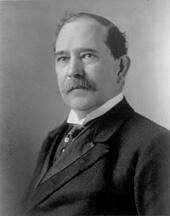
George Turner, an American politician and jurist, was born on February 25, 1850, near Edina in Knox County, Missouri. Raised in the rural Midwest in the years following the Mexican–American War and amid the growing sectional tensions that would culminate in the Civil War, he came of age in a period of rapid national expansion and political realignment. His early life in Missouri exposed him to frontier conditions and the evolving legal and political institutions of the post–Civil War United States, influences that would later shape his career in law and public service.
Turner received his early education in the common schools of Missouri, reflecting the limited but expanding educational opportunities available in the mid-19th century American West. He studied law as was customary at the time, through apprenticeship and independent reading rather than formal law school training, and was admitted to the bar in 1873. His legal training prepared him for a career that would move steadily westward, aligning his personal trajectory with the broader national movement toward the Pacific coast.
After his admission to the bar, Turner practiced law in Missouri before relocating to the western territories, where legal institutions were still being formed and refined. He eventually settled in the Pacific Northwest, where his abilities as a lawyer and jurist brought him increasing prominence. Turner served as a justice of the Territorial Supreme Court of Washington, a position in which he helped shape the legal framework of the territory prior to its admission as a state in 1889. His judicial service in the territorial period established his reputation as a capable and respected legal authority and provided him with a deep familiarity with the region’s economic and political concerns.
With Washington’s transition from territory to statehood and the continued development of its political institutions, Turner moved from the judiciary into elective office. A member of the Democratic Party, he became one of the leading political figures in the young state. In 1897 he was elected as a United States Senator from Washington, at a time when senators were still chosen by state legislatures rather than by direct popular vote. His election reflected both his standing within the Democratic Party and the confidence placed in him by Washington’s political leadership during a period of intense national debate over economic and foreign policy.
Turner served a single term in the United States Senate from March 4, 1897, to March 3, 1903. His tenure in Congress coincided with a significant period in American history, encompassing the aftermath of the economic Panic of 1893, the Spanish–American War of 1898, and the early stages of the United States’ emergence as an overseas imperial power. As a senator, he participated in the legislative process and contributed to debates on issues central to the era, including questions of currency, economic regulation, and the governance of newly acquired territories. Throughout his term, he represented the interests of his Washington constituents while taking part in the broader democratic process that shaped national policy at the turn of the 20th century.
After leaving the Senate in 1903, Turner returned to the practice of law and continued to be involved in public affairs, drawing on his long experience as both jurist and legislator. Although he did not return to the Senate, his single term in office and prior territorial judicial service left a lasting imprint on the legal and political development of Washington State. George Turner died on January 26, 1932, in Spokane, Washington. His career, spanning from the Reconstruction-era Midwest to the early 20th century Pacific Northwest, reflected the broader trajectory of American expansion and institutional growth, and his service in the United States Senate from 1897 to 1903 marked his most prominent contribution to the nation’s public life.
Congressional Record