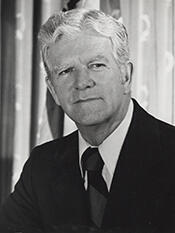
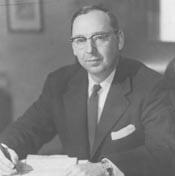
George Tucker was the name of several notable public figures whose careers spanned law, politics, religion, the arts, sports, and academia in the English-speaking world from the eighteenth through the twentieth centuries. The earliest and most historically prominent among them was St. George Tucker (1752–1827), a jurist and professor of law at the College of William & Mary in Virginia, and George Tucker (1775–1861), a United States Representative and author. In later generations, other individuals named George Tucker emerged in Canada, Bermuda, the United States, and Puerto Rico, as well as in popular culture, each distinguished in his respective field.
St. George Tucker was born in 1752 and became one of the early American republic’s influential legal scholars. After emigrating from Bermuda to Virginia, he established himself in the legal profession and ultimately joined the faculty of the College of William & Mary, where he served as a professor of law. In that role he helped shape the education of early American lawyers and jurists at one of the nation’s oldest institutions of higher learning. Tucker is historically associated with early efforts to adapt English common law to the new constitutional framework of the United States, and his work contributed to the development of American legal thought in the post-Revolutionary era. He remained active in legal and academic circles until his death in 1827.
George Tucker, the American author and public official, was born in 1775 and became a prominent figure in early nineteenth-century United States politics and letters. He served as a U.S. Representative, reflecting the growing participation of educated professionals in the national legislature during the formative decades of the republic. In Congress he was part of the generation that grappled with issues of national expansion, economic policy, and the evolving balance between federal and state authority. Alongside his legislative service, Tucker was also an author, contributing to the intellectual life of the young nation through works that engaged with history, economics, and public affairs. His dual career as a U.S. representative and author extended well into the mid-nineteenth century, and he lived until 1861, witnessing the mounting sectional tensions that preceded the Civil War.
In Canada, George Tucker is remembered as a provincial legislator who served as a Member of Provincial Parliament (MPP) in Ontario. As an Ontario MPP, he participated in the governance of the province within the Canadian parliamentary system, working on matters of local and regional concern in a period when provincial legislatures were central to questions of infrastructure, education, and economic development. His service as an Ontario MPP placed him among the cadre of public officials responsible for shaping policy and representing constituents in the evolving political landscape of Ontario.
Another nineteenth-century figure bearing the name was George Tucker (1835–1908), an Anglican priest who rose to the position of archdeacon of Bermuda. Born in the mid-nineteenth century, he pursued a religious vocation within the Anglican Church and devoted his career to ecclesiastical service in Bermuda, a British territory in the North Atlantic. As archdeacon of Bermuda, he held a senior clerical office, overseeing clergy, church administration, and pastoral work across the islands. His tenure coincided with a period of social and economic change in Bermuda, and his leadership in the church extended until his death in 1908.
In the realm of the arts, George Loane Tucker (1872–1921) became an important early American film director and screenwriter during the silent film era. Born in the late nineteenth century, he entered the motion picture industry as it was emerging as a new form of mass entertainment. Tucker directed and wrote for films at a time when narrative cinema was developing its basic techniques and storytelling conventions. His work contributed to the establishment of American film as a significant cultural and commercial enterprise in the early twentieth century, and he remained active in the industry until his death in 1921.
The name George Tucker also appears prominently in twentieth-century American music and sports. George Tucker (1927–1965) was a jazz bassist who performed during a period of great innovation in jazz. Active in the mid-twentieth century, he contributed to the rich tradition of American jazz performance, working with ensembles and bandleaders in an era marked by the evolution of bebop, hard bop, and other modern jazz styles. Another contemporary namesake, George Tucker (1929–2013), pursued a career in athletics as an American football coach. Over the course of his coaching career, he worked with players and teams in a sport that was becoming one of the most popular in the United States, helping to develop talent and strategy at the collegiate or professional levels until his death in 2013.
In the sciences and international sport, George Tucker (born 1947) distinguished himself as a Puerto Rican physicist and former Olympic luger. Trained in physics, he pursued an academic or research career while also competing in the sport of luge, representing Puerto Rico in international competition. His participation as an Olympic luger highlighted both his athletic ability and the broader involvement of smaller nations in winter sports traditionally dominated by countries with colder climates. His dual identity as a physicist and Olympian reflects the diverse paths taken by individuals sharing the George Tucker name.
The name has also entered contemporary popular culture through the fictional character George Tucker, portrayed by actor Scott Porter on the television series “Hart of Dixie.” In that series, which aired in the early twenty-first century, George Tucker is depicted as a central character in a small Southern town, embodying themes of community, personal relationships, and regional identity. While fictional, this portrayal underscores the continued resonance and recognizability of the name George Tucker in modern media, extending a long historical line of real individuals who have carried the name in public life.
Congressional Record