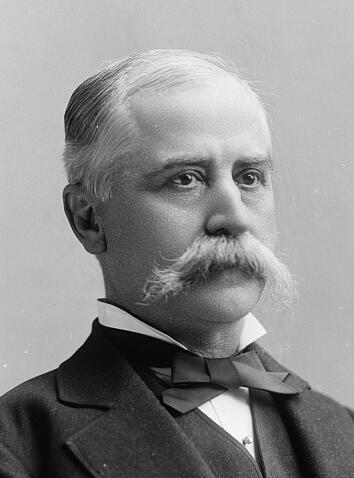
George Ebbert Seney (May 29, 1832 – June 11, 1905) was a 19th-century American politician, lawyer, and judge from Ohio who served four terms as a Democratic Representative in the United States House of Representatives from 1883 to 1891. A member of a politically connected family, he was the grandson of Joshua Seney and was also descended from colonial Governor of Maryland Francis Nicholson. Over the course of his career he combined legal practice, judicial service, military duty in the Civil War, and national legislative service, representing the interests of his Ohio constituents during a significant period in American history.
Seney was born in Uniontown, Pennsylvania, on May 29, 1832. In the year of his birth, he moved with his parents to Tiffin, Seneca County, Ohio, which would remain his principal home for the rest of his life. He was educated in Ohio and attended Norwalk Seminary, a prominent educational institution in the region. His family background, including his connection to Joshua Seney and Governor Francis Nicholson, placed him in a tradition of public service that helped shape his later professional and political trajectory.
After completing his studies, Seney read law and was admitted to the bar in 1853. He commenced the practice of law in Tiffin, quickly establishing himself in the local legal community. His professional reputation grew to the point that President James Buchanan tendered him an appointment as United States Attorney for the Northern District of Ohio, an offer he declined. In 1857 he was elected judge of the court of common pleas, a significant judicial position in Ohio’s state court system, where he served prior to the outbreak of the Civil War. His early legal and judicial work laid the foundation for his later influence in both state and national affairs.
During the American Civil War, Seney entered military service in the Union Army. In 1862 he enlisted in the 101st Ohio Infantry, a volunteer regiment. He was promoted to first lieutenant and later served as quartermaster of the regiment, managing essential supplies and logistics until the close of the war. His wartime service added to his public standing in Ohio and reflected his commitment to the Union during a period of national crisis.
Following the war, Seney resumed his legal career and became increasingly active in Democratic Party politics. In 1874 he was a candidate for the United States House of Representatives but narrowly lost the election by fewer than 140 votes. Remaining engaged in party affairs, he served as a delegate to the Democratic National Convention in 1876. His persistence in political life and his growing prominence within the Democratic Party eventually led to his successful election to Congress.
Seney was elected as a Democrat to the United States House of Representatives in 1882 and took his seat in the Forty-eighth Congress on March 4, 1883. He served four consecutive terms, remaining in office through the Forty-ninth, Fiftieth, and Fifty-first Congresses, and his congressional service extended from March 4, 1883, to March 3, 1891. As a member of the House of Representatives during a significant period in American history, he participated in the legislative process and represented the interests of his Ohio constituents, contributing to debates and decisions on issues confronting the post–Civil War and Gilded Age United States. A member of the Democratic Party, he did not seek renomination in 1890, thus concluding his congressional career after eight years in office.
After leaving Congress, Seney returned to Tiffin and resumed the practice of law. He remained a respected figure in his community and in Ohio legal and political circles. His personal life reflected his deep roots in Tiffin: he married Anna Walker, the granddaughter of Josiah Hedges, the founder of Tiffin, further linking him to the city’s early history. His family connections extended into public life beyond Ohio; Congressman George Ebbert Seney was the cousin of John Van Kirk Ebbert, sergeant in the 1st Regiment, West Virginia Infantry Volunteers, Union Army, and he was the great-uncle of William B. Ebbert, a member of the Colorado General Assembly from 1889 to 1890, 1907 to 1908, and 1911 to 1912. In addition to his judicial and legislative roles, he was recognized among the nation’s legal elite, serving as a pallbearer for Chief Justice Morrison Waite.
Seney continued his legal practice in Tiffin until his death there on June 11, 1905. He was interred in Greenlawn Cemetery in Tiffin, Ohio. His life and career, spanning law, the judiciary, military service, and four terms in the United States Congress, reflected a sustained commitment to public service at both the state and national levels.
Congressional Record