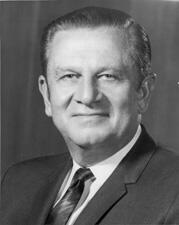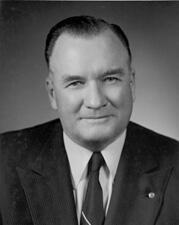
George Wilson Malone (August 7, 1890 – May 19, 1961) was an American civil engineer and Republican politician who represented Nevada in the United States Senate from 1947 to 1959. Over two terms in office, he contributed to the legislative process during a significant period in American history, participating in the democratic process and representing the interests of his Nevada constituents.
Malone was born on August 7, 1890, in Fredonia, Kansas. As a young man, he moved west to Reno, Nevada, where he began working as a civil and hydraulic engineer. While employed in this field, he attended the University of Nevada, Reno, combining practical engineering work with formal study. He graduated from college in 1917, just as the United States was entering World War I.
Following his graduation, Malone enlisted in the United States Army when the nation entered World War I. He initially served in the artillery, later becoming a regimental intelligence officer. In this capacity, he served in England and France until 1919. After his military service concluded, he returned to Nevada and resumed his engineering career, building on his experience in civil and hydraulic engineering.
In the postwar years, Malone advanced professionally and entered public service as an engineer. He served as the state engineer of Nevada from 1927 to 1935, a position in which he oversaw important aspects of the state’s water and infrastructure development. His technical expertise and public role as state engineer helped establish his reputation and laid the groundwork for his later political career.
Malone formally entered electoral politics in 1934, when he made his first attempt to win a seat in the United States Senate from Nevada. Running as a Republican, he challenged Democratic incumbent Key Pittman but was defeated, receiving 33 percent of the vote. During World War II, Malone returned to the national arena in a technical capacity, working for the United States Senate as an engineering consultant on war materials. He again sought a Senate seat in 1944, this time opposing Democratic incumbent Pat McCarran; although he improved his showing, he was again defeated, receiving 41 percent of the vote.
In 1946, Malone mounted a successful campaign for the United States Senate. Running as a Republican, he defeated the Democratic candidate, former Senator Berkeley L. Bunker, winning 55 percent of the vote. He took office in January 1947 and was reelected in 1952 with 51 percent of the vote, serving continuously until January 1959. During his two terms, Malone was known as an isolationist who supported protective tariffs, reflecting a generally conservative and nationalist approach to foreign trade and international engagement. His Senate service coincided with the early Cold War, the beginning of the nuclear age, and the postwar economic expansion, and he participated in the legislative deliberations of this transformative era while representing Nevada’s interests in areas such as natural resources, infrastructure, and economic development.
Malone sought a third term in the Senate in 1958 but was defeated for reelection by Democrat Howard W. Cannon, receiving 42 percent of the vote. After leaving the Senate in January 1959, he remained in Washington, D.C., where he continued to work as an engineering consultant, drawing on his long experience in both engineering and public affairs. In 1960, he made a final bid for elective office, running for a seat in the United States House of Representatives from Nevada, but he was again unsuccessful.
George Wilson Malone died from cancer in Washington, D.C., on May 19, 1961, less than a year after his final campaign, at the age of 70. He was interred at Arlington National Cemetery, reflecting both his military service in World War I and his long tenure in national public life.
Congressional Record