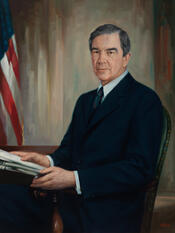
George Herman Mahon (September 22, 1900 – November 19, 1985) was an American politician and attorney who served as a Representative from Texas in the United States Congress from 1935 to 1979. A member of the Democratic Party, he served 22 consecutive terms in the House of Representatives, becoming one of the longest-serving members from Texas and, in his final years in office, the Dean of the House. Over more than four decades, Mahon contributed to the legislative process during a significant period in American history, representing the interests of his constituents while playing a central role in federal appropriations and national defense policy.
Mahon was born near Haynesville, Claiborne Parish, Louisiana, on September 22, 1900. When he was a child, his family moved to Texas, where he was raised and would spend the bulk of his personal and professional life. Growing up in rural West Texas, he became closely acquainted with the agricultural and economic concerns of the region, experiences that later informed his legislative priorities and his reputation as a careful steward of federal spending.
Mahon pursued higher education in Texas, graduating from Hardin–Simmons University in Abilene in 1924. He then attended the University of Texas School of Law in Austin, receiving his law degree in 1925. After completing his legal studies, he was admitted to the bar and began practicing law in Texas. His early legal career quickly led him into public service at the local and regional levels, where he developed a reputation for diligence and integrity.
In 1926, Mahon was elected county attorney for Mitchell County, Texas, marking his first public office. The following year, in 1927, he became district attorney of the 32nd judicial district of Texas, a position he held until 1933. In these prosecutorial roles, he gained experience in courtroom practice and public administration, and he became well known across the region. His work as district attorney helped establish the political base and public recognition that would support his subsequent election to Congress.
Mahon was first elected to the United States House of Representatives in 1934 and took his seat in January 1935. A Democrat, he represented a largely rural West Texas district and was repeatedly returned to office by his constituents, ultimately serving 22 terms until his retirement in 1979. During his tenure, he participated actively in the democratic process and was a delegate to each Democratic National Convention from 1936 to 1964. His service in Congress spanned the New Deal, World War II, the Cold War, the civil rights era, and the Vietnam War, placing him at the center of many of the twentieth century’s most consequential national debates.
Within the House, Mahon became particularly influential in matters of federal spending and national security. He was appointed to the powerful House Appropriations Committee, where he rose through the ranks and eventually became its chairman in 1964. He held the chairmanship from 1964 until his retirement from the House in 1979. In this role, he exercised substantial authority over the federal budget, especially defense and foreign aid appropriations, and was widely regarded as a key figure in shaping U.S. fiscal policy during the height of the Cold War. He was also appointed to the special congressional panel overseeing aspects of the Manhattan Project during World War II, giving him early involvement in the legislative oversight of the nation’s nuclear weapons program. For the last three years of his House service, he was recognized as the Dean of the House, reflecting his status as its longest continuously serving member.
Mahon’s long tenure also intersected with the major civil rights struggles of the mid-twentieth century, and his voting record reflected the opposition of many Southern Democrats to federal civil rights legislation. He voted against the Civil Rights Acts of 1957, 1960, 1964, and 1968, which were directed at enforcing constitutional rights for African Americans and other minorities. He also opposed ratification of the Twenty-Fourth Amendment to the U.S. Constitution, which abolished the poll tax in federal elections, and he voted against the Voting Rights Act of 1965, which gave the federal government oversight and enforcement authority over state practices that discriminated against minority voters. These positions placed him among the conservative wing of his party on racial and voting rights issues, even as he maintained strong support in his home district.
After leaving Congress in 1979, Mahon remained in Washington, D.C., and continued his involvement in public and cultural institutions. He had served as a regent of the Smithsonian Institution from 1964 to 1978, reflecting his interest in national museums and the preservation of American history and culture. Following his retirement from the House, he continued to work with the Smithsonian, lending his experience in governance and appropriations to the institution’s development and oversight.
George Herman Mahon died on November 19, 1985, in San Angelo, Texas, due to complications from surgery. He was interred in the Loraine City Cemetery in Loraine, Texas, returning in death to the region he had long represented. His papers, spanning the years 1887 to 1986 and including materials from his extensive congressional career, are preserved in the Southwest Collection/Special Collections Library at Texas Tech University, providing a detailed record of his role in Congress and his influence on mid-twentieth-century American legislative history.
Congressional Record