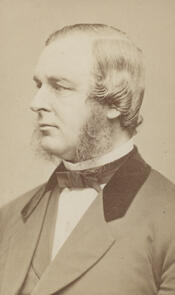
George Bailey Loring (November 8, 1817 – September 14, 1891) was an American physician, politician, and diplomat who served as a Republican member of the United States House of Representatives from Massachusetts from 1877 to 1881. Over the course of a long public career, he held a variety of state and federal offices, including service in both houses of the Massachusetts legislature, as United States commissioner of agriculture, and as United States minister to Portugal.
Loring was born on November 8, 1817, the son of Unitarian minister Bailey Loring and Sally Pickman (Osgood) Loring. He was a fourth great-grandson of Deacon Thomas Loring, an early settler in New England, and was connected through family ties to several prominent New England political figures. Raised in Massachusetts, he attended Franklin Academy in Andover, Massachusetts, where he received his early education and briefly taught school before pursuing higher studies.
Loring graduated from Harvard University in 1838 and continued his education at Harvard Medical School, from which he received his medical degree in 1842. After completing his medical training, he practiced medicine for a short time in North Andover, Massachusetts. He soon entered public service in a medical capacity, serving as surgeon of the Seventh Regiment, Massachusetts Volunteer Militia from 1842 to 1844. In 1843 he was appointed surgeon of the United States marine hospital at Chelsea, Massachusetts, a position he held until 1850. In 1849 he was appointed commissioner to revise the United States marine hospital system, reflecting his growing reputation in medical administration.
In 1851 Loring moved to Salem, Massachusetts, which became his principal home for much of his later life. On May 4, 1853, he was appointed postmaster of Salem, a federal office he held until February 16, 1858, when his successor was appointed. During these years he increasingly shifted from medicine to politics and public administration, aligning himself with the emerging Republican Party. His family connections also linked him to notable political figures: his great-uncle and his wife’s uncle, Benjamin Pickman Jr., had served as a Congressman from Massachusetts; another great-uncle was Samuel Osgood; and his third cousin, once removed, and his wife’s first cousin, twice removed, George P. Wetmore, would become Governor and United States Senator from Rhode Island.
Loring entered elective office as a member of the Massachusetts House of Representatives, serving from 1866 to 1867. He became an important figure in state Republican politics, serving as chair of the Massachusetts Republican State Committee from 1869 to 1876. He was elected to the Massachusetts Senate, serving from 1873 to 1876, and was president of that body during his tenure, including service in the 94th, 95th, 96th, and 97th Massachusetts General Courts (1873, 1874, 1875, and 1876). He was also active in national party affairs, serving as a delegate to the Republican National Conventions in 1868, 1872, and 1876. In 1872 he was appointed United States centennial commissioner for the Commonwealth of Massachusetts, participating in preparations for the nation’s centennial observances.
Loring was elected as a Republican to the Forty-fifth and Forty-sixth Congresses, serving as a Representative from Massachusetts in the United States House of Representatives from March 4, 1877, to March 3, 1881. His two terms in Congress coincided with a significant period in American history, as the nation emerged from Reconstruction and confronted new economic and political challenges. As a member of the House of Representatives, he participated in the legislative process, represented the interests of his Massachusetts constituents, and contributed to the work of the Republican majority in shaping federal policy. A member of the Republican Party throughout his congressional career, he sought renomination in 1880 but was unsuccessful.
After leaving Congress, Loring continued his service in the federal government. In 1881 he was appointed United States commissioner of agriculture, a post he held until 1885. In this capacity he oversaw federal efforts to support and modernize American agriculture during a period of rapid economic and technological change. Later, in 1889, he was appointed United States minister to Portugal, representing American diplomatic interests in Lisbon. He served in that position until his resignation in 1890, after which he returned to Massachusetts.
Loring’s personal life reflected his deep roots in New England’s professional and political families. He married Mary Toppan Pickman (1816–1878), daughter of Dr. Thomas Pickman and Sophia Palmer Pickman, and also his cousin, thereby reinforcing longstanding family ties between the Loring, Pickman, Osgood, and related families. After Mary’s death in 1878, he married Anna Smith Hildreth in 1880. Anna was the daughter of Isaac Townsend Smith, a former United States consul to Siam, and the widow of Charles Henry Hildreth, further linking Loring to families with a tradition of public service and international engagement.
George Bailey Loring died in Salem, Massachusetts, on September 14, 1891, at the age of seventy-three. He was interred in Harmony Grove Cemetery in Salem, closing a career that spanned medicine, state and national politics, and diplomatic service.
Congressional Record