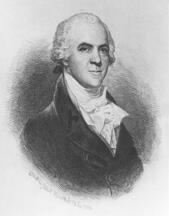
George Logan was an American physician, farmer, and statesman who represented Pennsylvania as a United States Senator from 1801 to 1807. Born on September 9, 1753, at “Stenton,” the historic Logan family estate near Germantown, Pennsylvania, he was a member of a prominent Quaker family; he was the great-grandson of James Logan, colonial secretary to William Penn. His early life was shaped by the social and political milieu of colonial Pennsylvania and by the traditions of public service and civic responsibility that characterized his family.
Logan received his early education in Pennsylvania before being sent abroad for advanced study. He traveled to Europe and studied medicine at the University of Edinburgh in Scotland, one of the leading medical schools of the era, where he completed his medical training. After returning to Pennsylvania, he practiced as a physician for a time, but he soon turned much of his attention to agriculture and the management of the Stenton estate, becoming known as a progressive farmer interested in agricultural improvement.
Logan’s political career developed in the turbulent years surrounding the American Revolution and the early national period. Although raised a Quaker, a denomination generally opposed to war, he supported the American cause and later aligned himself with the emerging Jeffersonian Republican movement. He served in the Pennsylvania legislature, where he became identified with Republican opposition to Federalist policies. In 1798, during the Quasi-War with France, he undertook an unofficial peace mission to Paris in an effort to ease tensions between the United States and France. This private diplomatic initiative, though undertaken without formal authorization, reflected his strong belief in negotiation over conflict.
The controversy surrounding this mission led directly to the passage by the Federalist-controlled Congress of the so‑called Logan Act of 1799, which sought to prohibit private citizens from conducting unauthorized diplomacy with foreign governments. Although the law was widely understood to have been prompted by his actions, Logan himself was not prosecuted under it. The episode, however, made him a nationally recognized figure and further solidified his standing within the Republican Party as a critic of Federalist foreign policy and an advocate of more conciliatory approaches to international disputes.
In 1801 Logan was elected as a Republican to the United States Senate from Pennsylvania, serving one full term from March 4, 1801, to March 3, 1807. His service in Congress occurred during a significant period in American history, encompassing the presidency of Thomas Jefferson and major developments such as the Louisiana Purchase and ongoing debates over the judiciary, federal power, and relations with Britain and France. As a member of the Senate, George Logan contributed to the legislative process during his one term in office, participating in the democratic process and representing the interests of his Pennsylvania constituents while supporting the broader Jeffersonian program of limited federal government and agrarian republicanism.
After leaving the Senate in 1807, Logan returned to private life at Stenton, where he continued to be active in agriculture and local civic affairs. He remained a respected figure in Pennsylvania, known both for his earlier medical training and for his long engagement in public service at the state and national levels. He lived to see the maturation of the young republic whose early political struggles had shaped his career. George Logan died on April 9, 1821, at his family estate near Germantown, Pennsylvania, closing a life that spanned from the colonial era through the first decades of the United States and that left a lasting imprint on both Pennsylvania politics and the nation’s early diplomatic history.
Congressional Record