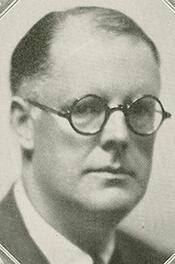
George Murray Hulbert (May 14, 1881 – April 26, 1950) was an American lawyer, jurist, and Democratic politician who served as a United States Representative from New York and later as a United States District Judge of the United States District Court for the Southern District of New York in the early twentieth century. He was born on May 14, 1881, in Rochester, New York, and moved in childhood to Waterloo, New York, where he attended the public schools. His early years in upstate New York provided the foundation for a career that would span private legal practice, municipal administration, national legislative service, and federal judicial office.
Hulbert pursued legal studies in New York City and received a Bachelor of Laws degree from New York University School of Law in 1902. That same year he was admitted to the bar and commenced private practice in New York City. He remained in private practice from 1902 to 1934, building a legal career that ran parallel to his increasing involvement in public affairs. His work as an attorney in the nation’s largest city brought him into contact with the political and commercial life of New York, positioning him for subsequent roles in municipal and federal government.
A member of the Democratic Party, Hulbert was elected to the United States House of Representatives as a Democrat to the Sixty-fourth and Sixty-fifth Congresses. He represented New York in the House from March 4, 1915, to January 1, 1918, thus serving during a significant period in American history that included the nation’s entry into World War I. During his two terms in office, Hulbert contributed to the legislative process, participated in the democratic governance of the country, and represented the interests of his New York constituents. His service in Congress, which ran from 1915 to 1919 as measured by the span of those Congresses, marked his emergence as a prominent Democratic figure in both state and national politics, even though he left the House before the formal end of his second term on January 1, 1918.
Hulbert resigned from Congress to assume important responsibilities in New York City government. Beginning in 1918, he served as Commissioner of Docks and Director of the Port of New York City, positions that placed him at the center of the city’s maritime commerce and infrastructure at a time when port facilities were vital to both wartime and postwar economic activity. In November 1921 he was elected President of the Board of Aldermen of New York City, an office he held from 1921 to 1925. In that capacity he was the second-highest-ranking official in the city’s government and, during the long illness of Mayor John Francis Hylan, Hulbert served as acting Mayor of New York City, exercising the mayoral functions during Hylan’s incapacity.
In addition to his municipal roles, Hulbert was involved in regional transportation and development enterprises. He served as President of the Boston, Cape Cod and New York Canal Company, an important waterway concern linking New England and New York maritime routes. His prominence in public life also led to his selection for state-level responsibilities, and he accepted an honorary position as a member of the Finger Lakes Park Commission offered by New York Governor Al Smith. This appointment, however, had significant consequences for his city career. In a decision by New York State Supreme Court Justice Joseph M. Proskauer, it was held that under section 1549 of the New York City Charter Hulbert had automatically vacated his position as President of the Board of Aldermen by accepting an appointment at the state level, and he was accordingly ousted from the presidency of the Board.
After continuing in private legal practice for many years alongside his public service, Hulbert was elevated to the federal judiciary during the administration of President Franklin D. Roosevelt. On June 6, 1934, Roosevelt nominated Hulbert to a seat on the United States District Court for the Southern District of New York, filling the vacancy created by the death of Judge Frank J. Coleman. The United States Senate confirmed his nomination on June 14, 1934, and he received his commission the following day, June 15, 1934. As a United States district judge, Hulbert presided over matters arising in one of the nation’s most important federal trial courts, which had jurisdiction over a broad range of civil and criminal cases in New York City and its environs.
George Murray Hulbert’s service as a federal judge continued until his death. He remained on the bench of the United States District Court for the Southern District of New York from 1934 until April 26, 1950, when his service was terminated by his death in Bayport, New York. He was interred in Gate of Heaven Cemetery in Valhalla, New York. His career, extending from local practice and city administration to the halls of Congress and the federal judiciary, reflected a lifetime of engagement in the legal and political institutions of New York and the United States.
Congressional Record