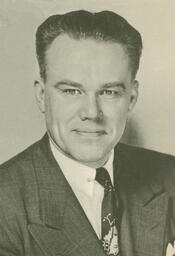
George Holcombe (March 1786 – January 14, 1828) was an American physician and politician who served as a United States Representative from New Jersey. Born in March 1786 in what was then Amwell Township, in Hunterdon County, New Jersey—an area that now includes part of Lambertville—he grew up in a region of rural central New Jersey that was developing rapidly in the early national period. His early life was shaped by the educational and civic opportunities available in the post-Revolutionary era, and he pursued formal schooling beyond the basic level typical of the time.
Holcombe completed his preparatory studies and graduated from the College of New Jersey (now Princeton University) in 1805, an institution that trained many future leaders in law, politics, and the professions. After his collegiate education, he turned to the study of medicine, enrolling in the medical department of the University of Pennsylvania in Philadelphia, one of the foremost medical schools in the United States in the early nineteenth century. He later continued his medical training in Trenton, New Jersey, further refining his clinical skills under established practitioners.
After completing his medical education, Holcombe was granted a license to practice by the Medical Society of New Jersey, the principal professional body overseeing medical standards in the state. He established a medical practice in Allentown, New Jersey, where he practiced from 1808 to 1815. During these years he served the health needs of a growing community, gaining local prominence and the trust of his neighbors. His work as a physician, combined with his education and standing in the community, helped lay the groundwork for his entry into public life.
Holcombe’s civic engagement expanded beyond medicine as he took on several local offices, participating in the governance of his community and county. His growing involvement in public affairs led to his election to the New Jersey General Assembly, where he served in 1815 and 1816. In the state legislature he joined other representatives in addressing issues of infrastructure, commerce, and governance during a period of expansion and political realignment in both New Jersey and the nation.
Building on his state-level experience, Holcombe was elected to the United States House of Representatives from New Jersey. He was first elected as a Democratic-Republican to the Seventeenth Congress and took his seat on March 4, 1821. As national politics evolved in the 1820s, he aligned with the emerging Jacksonian movement: he was elected as a Jacksonian Democratic-Republican to the Eighteenth Congress and was subsequently reelected as a Jacksonian to the Nineteenth and Twentieth Congresses. As a member of the Jackson Party representing New Jersey, George Holcombe contributed to the legislative process during four terms in office. His service in Congress occurred during a significant period in American history marked by debates over internal improvements, the national bank, and the expansion of democratic participation, and he took part in the democratic process by representing the interests of his New Jersey constituents in the national legislature.
Holcombe remained in office continuously from March 4, 1821, until his death. While still serving in Congress, he died in Allentown, New Jersey, on January 14, 1828. His death made him one of the members of the United States Congress who died in office during the nineteenth century. Holcombe’s remains were interred in the Congressional Cemetery in Washington, D.C., a burial ground that holds the graves of many early national legislators and public officials, underscoring his role in the federal government during a formative era of the United States.
Congressional Record