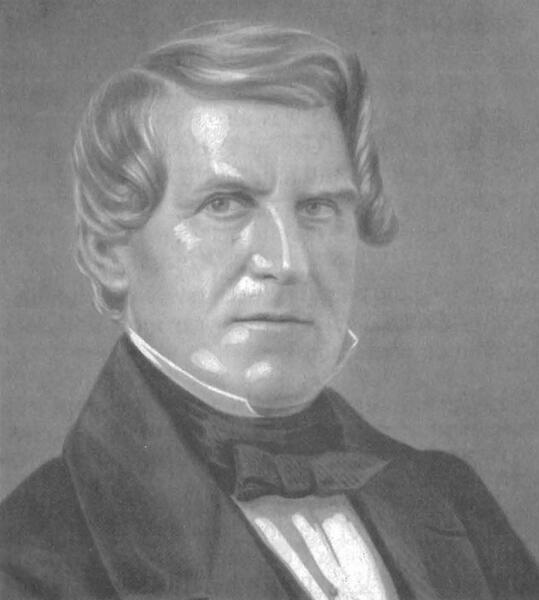
George Tisdale Hodges (July 4, 1789 – August 9, 1860) was an American politician and banker who served as a U.S. Representative from Vermont and is recognized as the first Republican member of the United States House of Representatives, although there was at the time a similar Opposition Party. He was born on July 4, 1789, in Clarendon, in what was then the Vermont Republic, and he attended the common schools. His early life was shaped by the transition of Vermont from an independent republic into a state of the new federal Union, providing the political and civic context in which he would later build his career.
Hodges’s formal education did not extend beyond the local common schools, but he entered business and finance at an early age, establishing himself in Rutland, Vermont. Involved in the banking industry in Rutland, he became a leading figure in local finance and economic development. He served as president of the Bank of Rutland for over twenty-five years, a tenure that reflected both his prominence in the community and his influence in the region’s commercial affairs. His long association with banking provided him with a reputation for prudence and stability that carried over into his public life.
Hodges began his political career in state government, aligning initially with the Whig Party. He served as a member of the Vermont House of Representatives from 1827 to 1829 and returned to the House in 1839 and 1840. During these terms he participated in the legislative process at a time when Vermont was addressing issues of internal improvements, local governance, and the evolving national debates of the antebellum period. His work in the state legislature helped establish him as a respected public servant and prepared him for higher responsibilities in state politics.
In the mid-1840s, Hodges advanced to the upper chamber of the state legislature. He served in the Vermont State Senate from 1845 to 1847, and in 1846 and 1847 he held the position of President pro tempore of the Senate. In that role he presided over the body in the absence of the lieutenant governor and played a central part in managing legislative business. His leadership in the Senate underscored his standing within the Whig Party and his influence in Vermont’s political life. In 1848 he further demonstrated his prominence in Whig circles by serving as a Whig Presidential Elector for Vermont in the presidential election of that year.
With the collapse of the Whig Party in the 1850s and the rise of new political alignments in response to the expansion of slavery and sectional tensions, Hodges became a Republican when that party was founded. As a member of the Republican Party representing Vermont, he contributed to the legislative process during one term in office. In 1856 he was elected as a Republican to the Thirty-fourth Congress to fill the vacancy caused by the death of Representative James Meacham. Hodges took his seat in the U.S. House of Representatives on December 1, 1856, and served until March 3, 1857. His service in Congress occurred during a significant period in American history, as the nation confronted intensifying disputes over slavery, territorial expansion, and party realignment. Although his tenure was brief, his election marked a milestone in national politics as he is regarded as the first Republican member of the United States House of Representatives. He was not a candidate for renomination in 1856 and returned to private life at the close of his term.
After leaving Congress, Hodges resumed his business and banking interests in Rutland, maintaining his role as a leading citizen of the community. He continued to be associated with the Bank of Rutland and remained engaged in local affairs, drawing on decades of experience in both finance and public service. His later years were spent in Rutland, where he had long been a central figure in civic and economic life.
George Tisdale Hodges died on August 9, 1860, in Rutland, Vermont. He was interred at Evergreen Cemetery in Rutland. His career spanned the formative decades of the early American republic through the turbulent 1850s, and his service in state government, his long leadership in banking, and his brief but historically notable tenure in Congress left a distinct mark on Vermont’s political and economic history.
Congressional Record