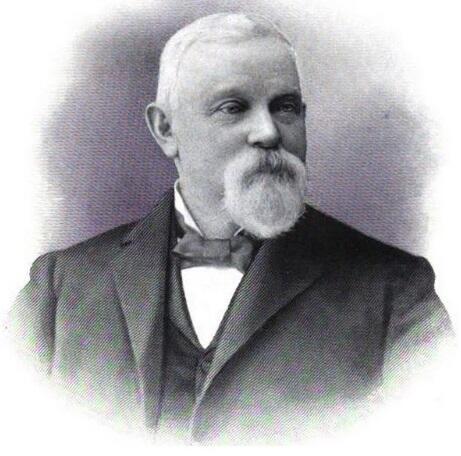
George Hires (January 26, 1835 – February 16, 1911) was an American Republican Party businessman and politician who represented New Jersey’s 1st congressional district in the United States House of Representatives for two terms from 1885 to 1889. He was born in Elsinboro Township, Salem County, New Jersey, on January 26, 1835, into a region characterized by its agricultural and commercial activity along the Delaware River. His early life in rural southern New Jersey helped shape his later involvement in local business and public affairs.
Hires attended the common schools of the area and continued his studies at the Friends’ School, reflecting the influence of Quaker educational traditions in southern New Jersey. In addition to his general schooling, he received commercial training that prepared him for a career in business. Equipped with this background, he engaged in mercantile and manufacturing pursuits, establishing himself as a businessman in Salem County. His experience in commerce and industry provided both the financial footing and the community standing that would support his entry into public service.
Hires’s political career began at the county level. He served as sheriff of Salem County from 1867 to 1869, a position that placed him at the center of local law enforcement and county administration during the post–Civil War era. His performance in that office contributed to his growing prominence in Republican politics in New Jersey. Building on this experience, he was elected to the New Jersey Senate, serving from 1881 to 1884. As a state senator, he participated in shaping legislation affecting New Jersey’s economic and civic life during a period of expanding industrialization and infrastructure development.
In 1884, Hires was elected as a Republican to the Forty-ninth Congress from New Jersey’s 1st congressional district, and he was reelected to the Fiftieth Congress, serving from March 4, 1885, to March 3, 1889. Representing a district that included important commercial and industrial communities in southern New Jersey, he contributed to the legislative process during a significant period in American history, participating in the democratic process and representing the interests of his constituents in the House of Representatives. His service coincided with national debates over tariffs, economic policy, and federal reform in the late nineteenth century. He chose not to be a candidate for renomination in 1888 to the Fifty-first Congress, thus concluding his congressional career after two terms.
After leaving Congress, Hires resumed his mercantile pursuits and expanded his activities into banking, reflecting his continued engagement with the economic development of his region. He remained active in Republican Party affairs at both the state and national levels. In 1894, he served as a delegate to the New Jersey State constitutional convention, participating in efforts to revise and modernize the state’s fundamental law. He was also a delegate to the 1896 Republican National Convention, which nominated William McKinley for the presidency, and he served for twelve years as a member of the Republican State committee, helping to shape party strategy and organization in New Jersey.
George Hires spent his later years maintaining his business interests and his influence within Republican political circles. He died in Atlantic City, New Jersey, on February 16, 1911. His remains were interred in the First Presbyterian Cemetery in Salem, New Jersey, returning him to the county where he had begun his career in business and public service.
Congressional Record